
Quantum dots (QDs) are known to be attractive for use in photovoltaics, optoelectronics, and photonics due to tunability of their properties by size, shape and surface chemistry [1]. Moreover, several QD properties can be modulated by electrochemical treatment. For instance, electrochemical injection of electrons into QD conduction band (CB) results in absorbance spectra change due to exciton absorption bleaching [2, 3].
Here we investigate electrochemistry and spectroelectrochemistry of CdSe QD films obtained by electrophoretic deposition on FTO. Cyclic voltammetry of CdSe QD films in NBu4PF6/acetonitrile electrolyte reveals two pairs of redox peaks, observable at -1.1 and -1.3 V (Fig. 1a) for 6.3 nm particles. The cathodic and anodic peaks correspond to electron injection to CdSe CB levels and its withdrawal after scan reversal which is seen by changes in absorbance spectra of films (Fig. 1b). Figure 1b shows CdSe QD film differentitial visible spectra variation in negative and positive scans of the electrode potential. As the electrode potential is scanned negatively, absorbance of the first exciton (635 nm) drops gradually and recoveres reversibly after scan reversal. The first exciton absorption was completely bleached and this indicates the whole filling of the 1Se level of each particle with electrons and that the whole film is electrochemically active. The changes in optical properties were also observable with a naked eye while the electrode potential was scanned.
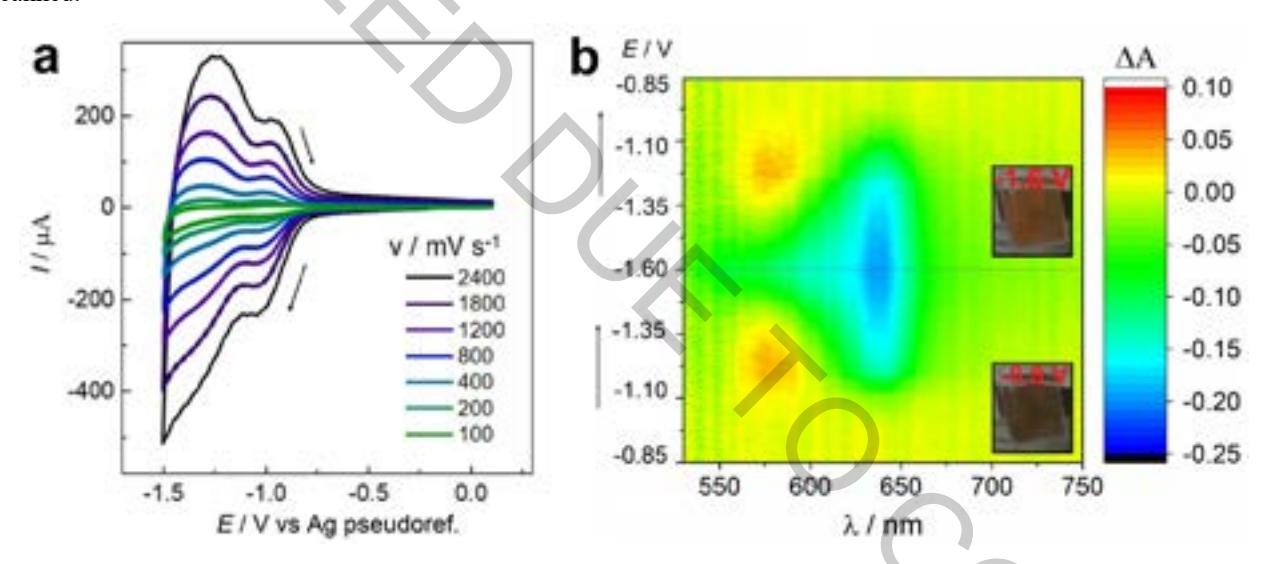
An analysis of electrochromism kinetics showed that the transition between charged and uncharged QD states completes within 200 ms for 500 nm thick films. We have also studied effects of the QD size, capping ligand length and film thickness on volatmmetric and spectroelectrochemical response.
Thus, our investigation has revealed fast and reversible electrochromic behavior of electrophoretically deposited CdSe QD films.