
Today, electro-nuclear systems based on high-current accelerators are considered as most promising ones for transmutation of spent nuclear fuel and energy production. The main reason is related to the usage of an accelerator as an external source which makes such systems safer to operate and easy to control the chain fission reaction.
A spallation target in Accelerator Driven system (ADS) is the main component due to generation of neutrons which then multiply in a subcritical reactor. Thus, it is necessary to calculate such characteristics as neutron yield and energy spectra, energy deposition, heating and activation of the target and production of long-lived fission fragments. These parameters can be defined using modern transport codes developed for simulation of the hadron-nucleus interactions over a wide energy range. In this work the Geant4 code was used with QGSP_BIC_HP standard physics list [1].
The model of uranium blanket with different insertions was developed to calculate the neutronics of the system. Integral data of neutron output, energy spectra and some reaction rates were calculated and compared with the experimental data [2] and the calculations with other codes [3]. The good agreement between experimental data and simulation results was obtained.
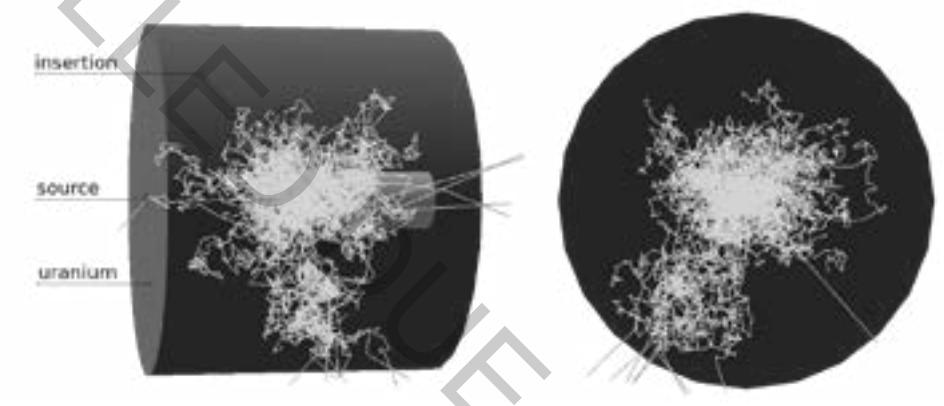
Simulation results demonstrate that the shape of neutron spectra with increasing of proton energy does not changed. There is an increase in the reaction rates and neutron flux only. However, energy spectra are slightly different depending on the insertion material.
It is planned the investigation of the reactions of fragmentation in the spallation targets as well as the formation of fission products in more detail. The current model should be refined to reduce simulation uncertainties and for clearer understanding of the kinetics of ADS.