
Plants that grow in extreme climatic conditions are a potential source of biologically active substances. Artemisia tilesii is a common herb in the Arctic Circle but has been virtually unexplored, making it a potential candidate for pharmaceutical use [1].
Artemisia tilesii seeds were used to induce in vitro culture. The seeds are stored in the seed bank of the Institute of Cell Biology and Genetic Engineering of NAS of Ukraine. Plants of Artemisia tilesii are cultured in vitro by hormone-free micropropagation [2].
The effect of Artemisia tilesii extract on the activity of 15-lipoxygenase in the reaction of enzymatic oxidation of linoleic acid was experimentally determined.
The studies were performed using a spectrophotometric method, recording an increase in the degree of absorption of the reaction mixture over time at a wavelength of 235 nm. This wavelength corresponds to the maximum absorption of the conjugated diene chromophore in a linoleic acid hydroperoxide molecule (molar absorption coefficient – $23\ 000\ M^{-1}\cdot cm^{-1}$) [3].
The activity of the enzyme was evaluated by the value of steady-state reaction rate ($V_{st}$) as the arithmetic mean of the three measurements with a deviation of not more than 5%.
The effect of Artemisia tilesii on the activity of 15-lipoxygenase was determined. The data obtained are presented in Figure 1 for concentrations of 25 μM, 50 μM and 100 μM Artemisia tilesii extract, respectively.
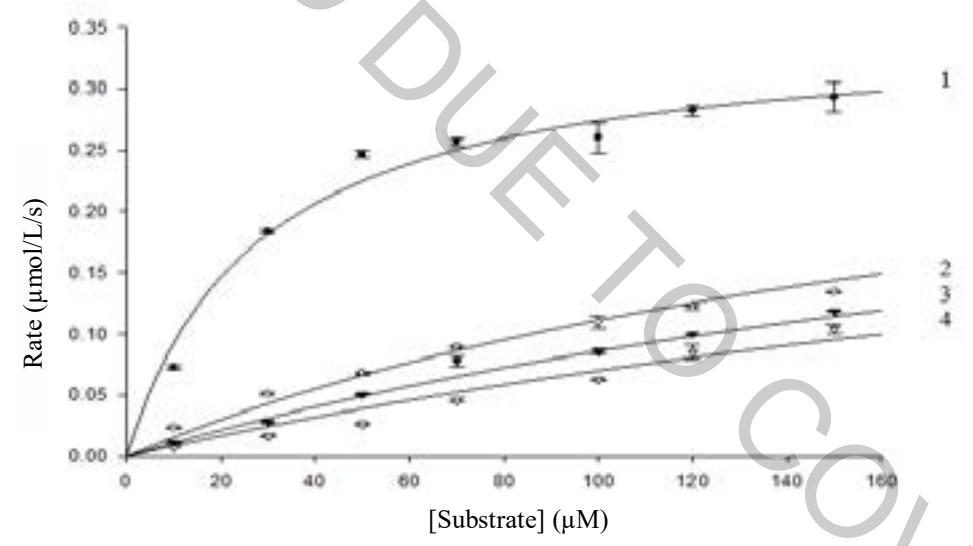
Conducted research have shown that Artemisia tilesii extract is an effective inhibitor of 15-lipoxygenase by a mixed (partial) inhibition mechanism. The results obtained suggest that Artemisia tilesii extract can be potentially used as an API for anti-inflammatory drugs because it has high efficacy as a 15-lipoxygenase inhibitor.