
Silicon materials are key semiconductors in all electronic and photonic devices and dominate the market for few decades [1]. The main drawback of Si and Ge, which are indirect band-gap semiconductors, is a lower performance in comparison to direct band-gap III-V semiconductors [2]. The development of new technology which would be able to shift photosensitivity of Si devices to the mid-infrared range, preserving the benefits of silicon, is in current effort [3]. Group IV GeSn based materials have recently shown promising optoelectronic characteristics, allowing to extend the detection range to the mid-infrared region [4]. The applications in short-wave infrared photo-sensors [5], and electrically driven lasers [6] on Si substrates show continuous improvement. Both these devices rely on the material electronic properties as carrier lifetime, carrier diffusion coefficient and diffusion length.
Therefore, in this work, we provide temperature-dependent studies of carrier lifetime, diffusion coefficient and diffusion length in Ge0.95Sn0.05 epilayer on silicon by applying contactless light-induced transient grating technique. Light-induced transient gratings is a variety of pump-probe technique, which employs an interference light field to photoexcite a sample under study. The interference field is created by two coherent laser beams (527 nm) that are made to overlap in the sample at an angle $\Theta$. A period $\Lambda$ of the resulting interference field is determined by the angle $\Theta$ and wavelength of the pump beam $\lambda_p$: $\Lambda=\lambda_p/(2\sin(\Theta/2))$. The probe (1053 nm) monitors the diffraction efficiency decay and allows to determine carrier diffusion coefficient (D) and lifetime ($\tau_R$) from grating decay rate $1/\tau_G = 1/\tau_R +4\pi^2D/\Lambda^2$. The determined temperature dependences of carrier lifetime and diffusivity are provided in Fig. 1.
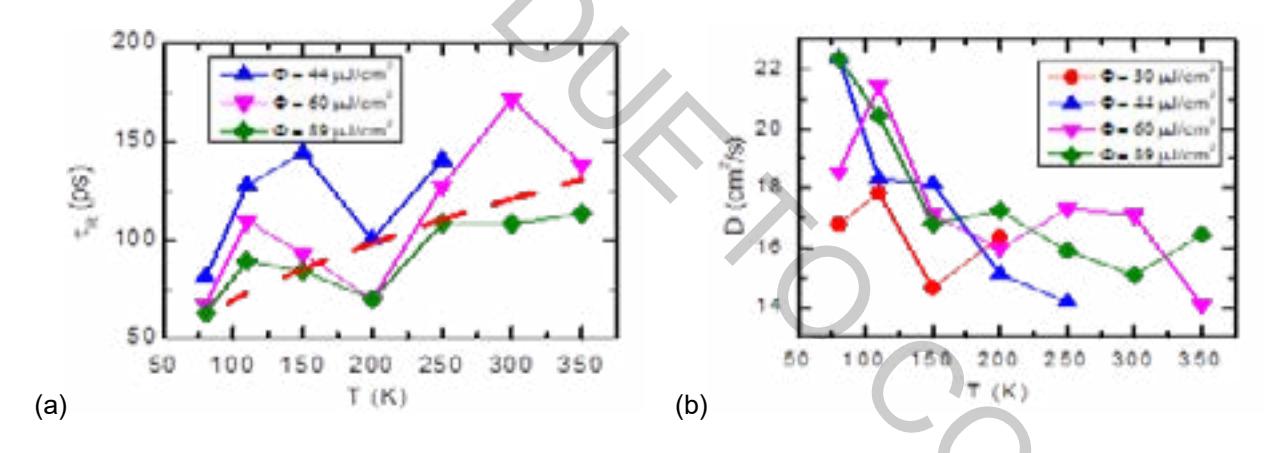
We show rather weak temperature dependences of these parameters and explain them by defect recombination and scattering processes. Lifetime increases with temperature due to reducing carrier capture cross-section, while diffusivity decreases due to increasing scattering by acoustic phonons. Weak excitation dependences of the parameters are related to saturated trap regime.