
Humidity plays an important role in many chemical and manufacturing processes as well as in human everyday life, for example air quality monitoring. Precise relative humidity (RH) measurements are also needed for various scientific studies. Currently available sensors, such as semiconductor, capacitive/resistive type sensors often have got longer response time, problems with accuracy, especially inaccurate at very low as well as very high humidity conditions. Transparent microresonator objects due to total internal reflection can trap light inside them, in such process constructive interference can occur, which is also known as whispering gallery modes (WGM). We use glycerol microdroplet WGM resonator. If relative humidity changes, refractive index and radius of the microresonator adjust to a new equilibrium condition as well and shift in resonances can be seen. Such system can be used as a high sensitivity and fast response relative humidity sensor. Comparing to silica or polymer based WGM humidity sensors [1][2] our prototype using glycerol is more sensitive to humidity, is temperature independent, and needs no fluorescent dye [3].
In this study, hygroscopic glycerol droplet (r = 0.5 mm, see Fig. 1a) was used as a micro resonator. Light from tunable laser was focused on the side of the droplet, constructive interference took place, whispering gallery modes were observed (see Fig. 1b). Benefits using tapered fiber instead of needle (for holding the droplet) such as stability, Van der Waals forces and eccentricity have been discussed. The main results show, that by increasing humidity, radius of the droplet increases. It is the main parameter influencing shift in modes. Theoretical equations were found, and they show the correlation between relative humidity and shift in resonant wavelength – by increasing humidity, resonant wavelength decreases. When relative humidity exceeds 75%, the rate of which droplet's size changes increases rapidly. Thereby, WGM humidity sensor could have extremely high precision in high humidity conditions (70-100% RH).
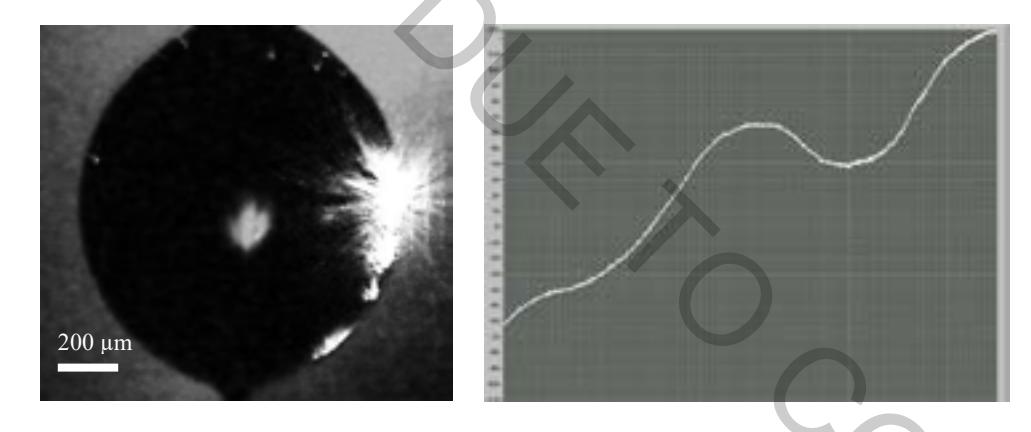
Promising liquid state WGM properties regarding polarization were observed. Depending on the place where the light was focused and the positioning of polarizer, smaller intensity modes with shorter free spectral range (FSR) were recorded. By following these drifting modes even higher sensitivity can be achieved. Our results also show that TE and TM polarization modes can be initiated in liquid state microresonators.
This study demonstrates properties of liquid state WGM resonator and discusses principles behind the prototype of optical humidity sensor. Further investigation about lifetime and work range of this type of sensor is needed. Experimental data about Q-factor degradation over time also needs to be recorded.