
The use of biomaterial into the human body is the restoration of certain tribological and biological functions. The Silicon (Si) doped diamond like carbon (DLC) coating deposited over Si (100) substrates by using thermal chemical vapour deposition (CVD) technique. Four different samples were made by varying the H2 flow rate from 30 to 90 sccm and the C2H2 flow rate kept constant as 9 sccm. The morphology, tribological and chemical composition of Si-DLC films were investigated by SEM, Nanoscratch and EDX respectively. From the EDX it has been observed that the Si percentage in the DLC film decreases with increase of H2 flow rate. The average coefficient of friction (${\mu}$) were calculated from Nanoscratch and it is noted that the surface of the films is smooth at lower H2 flow rate. The ${\sigma}$ is calculated by using the Stoney equation and it is presented in equation 1.
$$ \sigma = \frac{E_{S}}{6(1-c_{S})} \times \frac{c_{S}^{2}}{c_{f}} (\frac{1}{R_{2}} - \frac{1}{R_{1}})\tag{1} $$Where ts and tf are the thickness of the substrate and film, respectively. R2 is the curvature of the film and R1 is curvature of the Si substrate before deposition of the films. The vs and Es are the Poisson ratio and Young modulus of the substrate. The Es and Vs for Si (100) substrate are 127 GPa and 0.27 [2]. The residual stress of the film increases with increase of H2 flow rate which may be due to the presence of less Si at higher H2 flow rate. It is also noted that the antibacterial properties of Si-DLC thin film increased with the Si concentration. The bio test results demonstrate that the Si-DLC films are potentially useful biomaterials having both good tribological properties and antimicrobial characteristics. Fig.1 (a) and (b) shows the Cell Viability and hemolysis of Si-DLC thin films deposited at different H2 flow rate. In order find the hemocompatibility of Si-DLC thin film hemolysis test is performed and the hemolysis of Si doped DLC films were evaluated by performing MTT assay. In order to evaluate the cytocompatibility of the Si-DLC coating, we quantified the percentage of viable cells by the MTT cell viability assay [3].
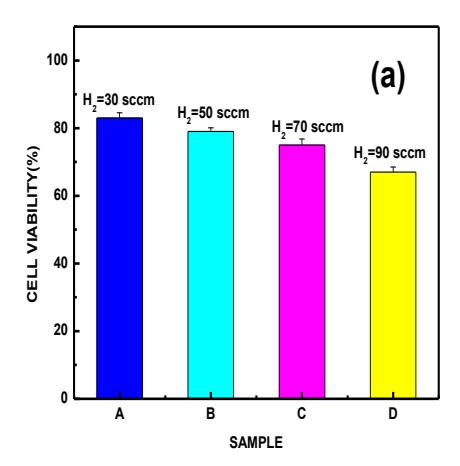
From the fig. 1 (a) it is observed that the cell viability of all the Si-DLC thin film is more than 65 % and it decreases with increase in temperature. The Si-DLC thin film deposited at lower H2 flow rate has the 83 % of cell viability which is highest among the four films. The increased cell viability could be due to the presence of Si particles in the surface of the film which facilitates efficient cellular communication and retains nutrient for longer duration. From the fig. 1(b) it is observed that the Si-DLC film deposited at lower H2 flow rate has the lowest % of hemolysis (1.71 %) and the DLC film deposited at higher H2 flow rate has the highest % of hemolysis (2.1 %). Thus, it is seen that higher Si content significantly reduced the hemolysis % which improves the biocompatibility of the films.