Photosynthesis is an important process used by plants and other organisms to convert light energy into chemical energy. Therefore, it is essential to have a good understanding of the processes that occur in these systems. Carotenoids in marine environment, including fucoxanthin in diatoms and peridinin in dinoflagellates, play an important role not only because of their high content relative to chlorophylls, but also because of a structural modification involving a carbonyl group that binds to the backbone of polyene. As a result, their light absorption range is extended to the blue-green range required for successful photosynthesis in the oceans. This property also makes carotenoids efficient channels for transferring the absorbed energy to chlorophyll-a. This functionality of carotenoids may be better understood by reference to the C2h point group of linear polyenes, where the strongly allowed $\pi$-$\pi$* transition is not to the lowest-energy singlet S1 state, but to a higher state, that is, S0 $\rightarrow$ Sn (often n=2). The large change in dipole moment indicates that carotenoid undergoes photoinduced charge transfer. [1]
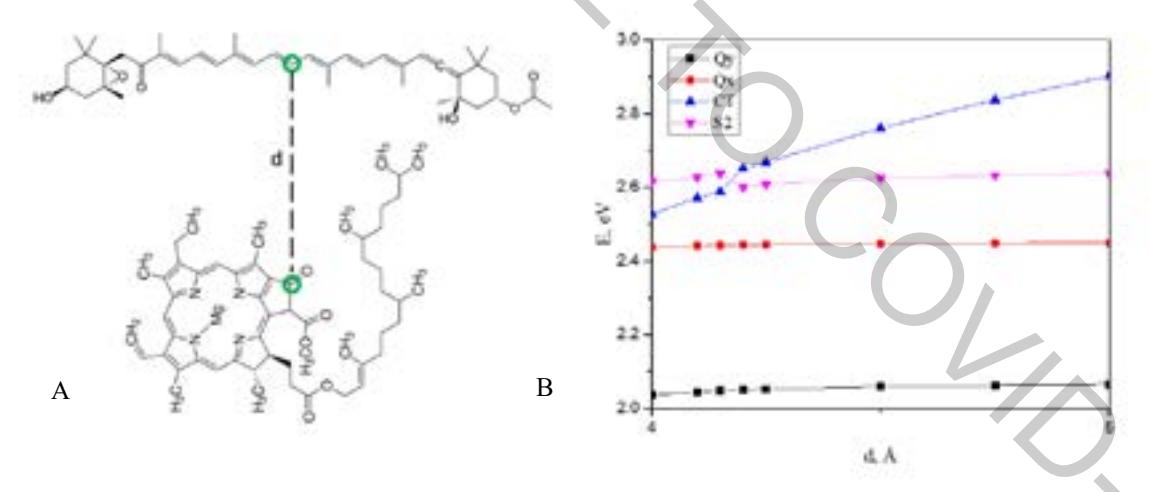
In this work Gaussian09 software [2] was used to analyze excited singlet states and to examine possible interactions of carotenoids fucoxanthin and peridinin with chlorophyll-a (Figure 1 A). The arrangements of complexes were taken as in PDB crystallographic structure 1PPR [3]. Computations were performed on resources at the High Performance Computing Center "HPC Sauletekis" in Vilnius University Faculty of Physics.
According to calculations the charge transfer state below carotenoid S2 state was observed in complexes 624. Results obtained were implying that for the existence of a charge transfer state below carotenoid S2 state the position between carotenoid and chlorophyll-a in complexes was crucial (Figure 1 B) as well as the structure of chlorophyll-a, especially a carbonyl group attached to a chlorin ring.
The results obtained may exist in the protein because the investigated structures are based on naturally existing protein amphidinium carterae. The possible excited states of the carotenoids and chlorophyll-a complexes discussed above and the conditions of the charge transfer state existence below the carotenoid S2 state were investigated.
The charge transfer state has not been fully analyzed. The results show that the charge transfer state depends on the positions between carotenoid and chlorophyll-a.