
Structural characteristics of silica materials are responsible for their physico-chemical behavior in different research fields. MCM-41-type silicas with hexagonally arranged homogeneous tunable pore channels of mesoscale size are the most promising materials in water purification, catalyst supporting, drug delivery, sensors design etc. Formation of mesoporous matrix of MCM-41 takes place at condensation of alkoxysilanes around supramolecular surfactant assemblies. Pore dimension of silica materials obtained by sol-gel synthesis can be regulated by addition of auxiliary organic compounds which change micelle configuration due to incorporation as cosurfactants or swelling agents.
In the present study, we analyzed the effect of azo dyes (ADs), alizarin yellow (AY) and methyl red (MR), as cosurfactants and their alkoxysilane derivatives as structure-forming silanes on mesostructure of silica materials prepared by base-catalyzed templated sol-gel synthesis. Potential ability of ADs to be incorporated into the long-chain alkylammonium aggregates due to arising of hydrophobic forces along with electrostatic interactions was proved by authors [1-3]. Organosilica materials with hexagonally arranged mesoporous structure were prepared by hydrothermal sol-gel condensation of tetraethyl orthosilicate and (3-aminopropyl)triethoxysilane in the presence of cetyltrimethylammonium and decyltrimethylammonium bromide as pore generating agents, ADs as cosurfactants, and their alkoxysilane derivatives as structure-forming silanes (Scheme).
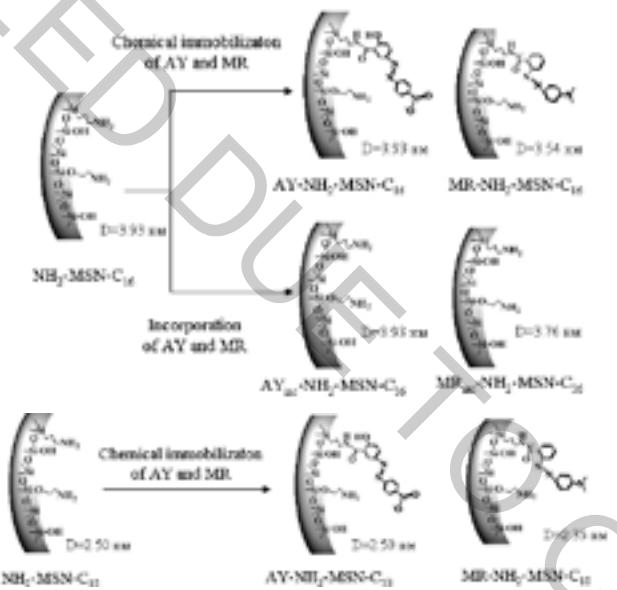
Mesostructure of resulting silicas was studied by low-temperature adsorption-desorption of nitrogen, x-ray diffraction analysis, and transmission electron microscopy. It was confirmed that the pore size, specific surface area and hexagonal arrangement of mesopores in synthesized silica nanoparticles were strongly affected by the AD additives. Solubilization of ADs by liquid crystal phase of long chain alkyltrimethylammonium salts and cooperative organization of dye-containing silanes with surfactants, involving penetration of aromatic groups of silanes into micelles, causes formation of more uniform mesoporous structure. As it was elucidated from the analysis of low-temperature adsorption-desorption of nitrogen, introduction of AD additives in sol-gel process results in noticeable increase of surface area, narrowing of pore size distribution and pore diameter. In accordance with the results of x-ray powder diffraction analysis, formation of silica materials which are characterized by the more distinct long-range ordering of porous structure takes place. Obviously, such changes in mesoporous structure of synthesized organosilicas are generated by penetration of hydrophobic parts of AY and MR or their alkoxysilane derivatives between chains of template micelles and drawing of silica matrix closure to the micelles core.