
Non-steroidal anti-inflammatory drugs (NSAIDs) are widely used pharmaceuticals. These drugs treat human and animal diseases in terms of analgesic, anti-inflammatory, and antipyretic actions. Consequently, NSAIDs are among the most detected drugs in the aquatic environment. Unfortunately, traditional mechanical and biological wastewater treatment technologies are insufficient for the removal of this type of contaminants [1]. The aim of this research was to study the removal of diclofenac and ibuprofen from aqueous medium by using modified starch.
Cross-linked cationic starch (CCS) microgranular sorbent was obtained by the means of chemical and physical modification of potato starch. CCS was obtained by cross-linking potato starch with 0.1 mol/AGU (anhydroglucoside unit) of epichlorohydrin and cationizated with 2,3-epoxypropyltrimethyammonium chloride using various molar ratios of reagents. The starch derivatives with the degree of substitution of quaternary ammonium groups of 0.21, 0.33 and 0.42 were synthesized. The CCS granules were additionally treated by using ultrasonication in water (treatment conditions: 40 kHz, 300 W, 30 sec., 24±1 °C). Sorbents granules were characterized by scanning electron microscopy (see Fig.1).
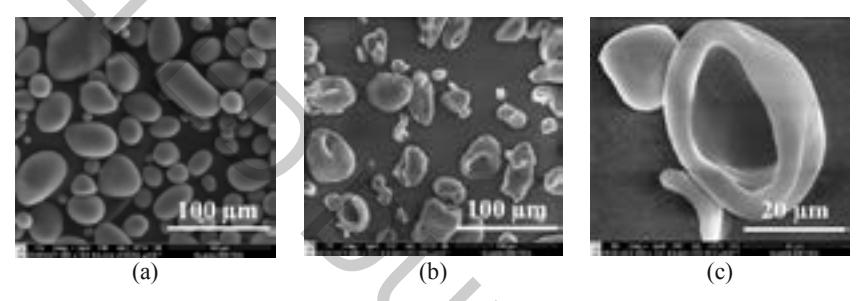
The diclofenac or ibuprofen were partially removed from water by adsorption onto CCS or ultrasound treated CCS granules (CCSU). The Langmuir, Freundlich and Dubinin-Radushkevich adsorption models have been used to describe the equilibrium adsorption of ibuprofen or diclofenac onto CCS and CCSU. According to the Langmuir adsorption model, the diclofenac and ibuprofen were adsorbed on quaternary ammonium groups of CCS or CCSU. The sorption ability of ultrasound treated sorbent was much higher in comparison to non-treated sorbent (see Table 1). For diclofenac, the highest sorption capacity of CCS and CCSU was 614 and 787 mg/g, respectively. Meanwhile, when binding ibuprofen, the highest sorption capacity of CCS and CCSU was 345 and 579 mg/g, respectively. Consequently, the binding improvement of diclofenac and ibuprofen on ultrasound treated sorbent granules was 28 % and 68 %, respectively.
| Sorbent | Adsorption of diclofenac | Adsorption of ibuprofen | ||
|---|---|---|---|---|
| QL (mg/g) | R2 | QL (mg/g) | R2 | |
| CCS/0.21 | 340 | 0.9999 | 232 | 0.9982 |
| CCSU/0.21 | 411 | 0.9992 | 574 | 0.9952 |
| CCS/0.33 | 629 | 0.9996 | 378 | 0.9916 |
| CCSU/0.33 | 738 | 0.9998 | 531 | 0.9982 |
| CCS/0.42 | 614 | 0.9996 | 345 | 0.9975 |
| CCSU/0.42 | 787 | 0.9994 | 579 | 0.9958 |
The values of Freundlich constant ($n_F$=2-5) and Dubinin–Radushkevich adsorption energy ($E_{DR}$=9-16) indicated that conditions for diclofenac or ibuprofen adsorption on CCSU were favourable and the ion-exchange mechanism was predominant during adsorption.