
The tremendous research efforts have been devoted to the oxygen electroreduction reaction (ORR), particularly with respect to potential application for fuel cells. The progress in fabrication of different anion-exchange membrane including hydroxyl-conducting polymer membrane has driven interest to Alkaline Fuel Cells [1]. The great deal of attention has been focused on development of suitable alternative electrocatalysts efficient enough in alkaline medium to replace platinum group metals. Thus, the systems based on gold nanoparticles (Au NPs) capable to ORR in alkaline medium have aroused interest as potential electrocatalyst for ORR [1]. Herein, we investigated the activity of 2 nm and 5 nm Au NPs deposited onto titania nanotubes (TNT) towards the ORR.
Tinania nanotubes were produced by two-stage anodization of Ti in ethylene glycol electrolyte containing 0.75 wt.% NH4F and 2 vol.% H2O. In order to obtain crystalline structure of anatase, the TiO2 nanotubes were annealed at 450 °C for 3 h in air. Colloidal Au NPs with an average diameter of 5 nm and 2 nm were fabricated via methods described in [2, 3]. To study the influence of Au NPs loading on the activity of Au-TNT systems in ORR, different amount of Au NPs (0.75÷3 μg/cm2) was deposited from sol onto TNT electrodes. Electrocatalytic activity of Au-TNT toward ORR was examined by cyclic voltammetry (CV) using an Autolab potentiostat in a 0.1 M KOH solution saturated with oxygen. The electrode potentials are referred with respect to a Hg/HgO (1 M KOH) reference electrode.
The annealed TNT samples have well-aligned nanotubular structure with a relatively narrow distribution of the inner diameter (60±5 nm) and the wall thickness (12±2 nm) of vertical nanotubes having a length of 10±1 μm. The Au NPs deposited on TNT are well separated and distributed both on the upper and on the inner side of the nanotubes.
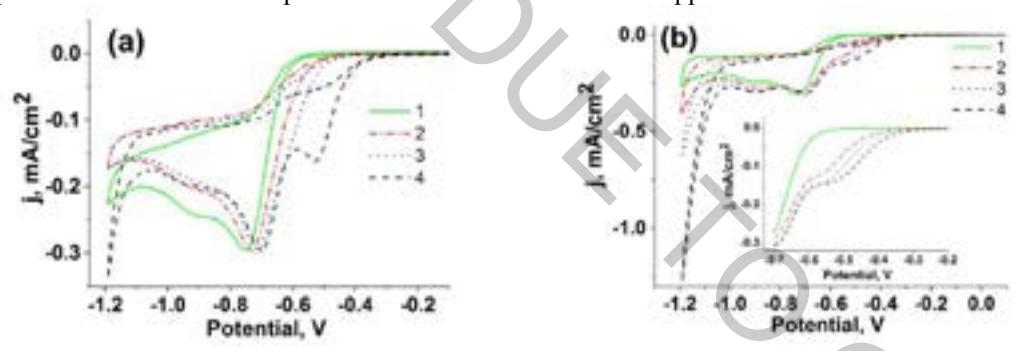
Oxygen electroreduction at the bare TNT electrodes demonstrates a cathodic wave at potentials more negative than -0.65 V. Deposition of Au NPs onto TNT leads to a decrease of overpotential toward ORR. Moreover, the behavior of Au-TNT systems depends on the surface concentration and the size of deposited Au NPs. In the case of 5 nm Au NPs, an increase of the amount of Au NPs from 0.75 to 3 μg/cm2 reduces the overvoltage of ORR by 0.1 V at a current density of 100 μA/cm2 (Fig. 1a). It is worth mentioning that the waves from Au NPs for the Au-modified systems containing 0.75 μg/cm2 and 1.5 μg/cm2 of Au NPs are superimposed on the ORR wave from TiO2, and their position cannot be determined unambiguously. For the TNT loaded with 3 μg/cm2 Au NPs, a clearly distinguishable additional wave, which can be related to ORR on Au surface, appears at less negative potentials. In case of 2 nm Au NPs, the additional Au-catalyzed wave is formed, already starting from 0.75 μg/cm2 of Au NPs (Fig. 2b). A 2- and 4-fold increase in the amount of deposited Au NPs leads to a decrease in the ORR overvoltage by 30 and 60 mV, respectively (Fig. 2b, insert). In general, the electrocatalytic activity of 2 nm Au NPs is slightly higher than those of 5 nm. When the Au NPs size reduces from 5 nm to 2 nm, provided that the amount of Au NPs is the same, half-wave potential of ORR on the gold surface is shifted by 10÷20 mV to the positive direction.
Thus, the ORR overvoltage of Au–TNT system depends on the size and concentration of Au NPs. A decrease of Au NPs size from 5 nm to 2 nm and an increase in the amount of nanoparticles leads to increasing the activity of Au–TNT systems in the process of O2 electroreduction.