
Pockels cell is one of the major components limiting the pulse repetition rate of high power laser sources. The birefringence in an the electro-optical crystal can be changed by variable electric voltage. It therefore acts as a voltage-controlled waveplate. This allows high frequency modulation of intercavity losses, unlocking the MHz frequency band for pulse repetition rate.
In this study Potassium Rubidium Titanyl Phosphate (KRTP) crystals were used due to their low quarter-wave voltage. This material property is critical for achieving high modulation frequency while maintaining steep edges ($~4$ ns) of high voltage (HV) pulses required in order to use the crystals in femtosecond regenerative amplifiers. In addition to birefringence, HV pulses induce converse-piezoelectric effect — deformation of the crystal when an external electric field is applied. When modulation frequency matches the natural frequency of the crystal, piezoelectric ringing occurs.
The effect of piezoelectric ringing on the polarisation contrast (PC) of the Pockels cells based on BBO crystals have already been studied in the modulation frequency range up to 1 MHz [1]. However, there are no studies dedicated to the analysis of the piezoelectric ringing behaviour of KRTP based Pockels cells in high modulation frequencies. The purpose of this work is to investigate this phenomena in the modulation frequency range up to 10 MHz.
We have investigated the behavior of 4 mm $\times$ 4 mm $\times$ 20 mm KRTP based Pockels cell by measuring its polarization contrast and surface temperature as a function of modulation frequency.
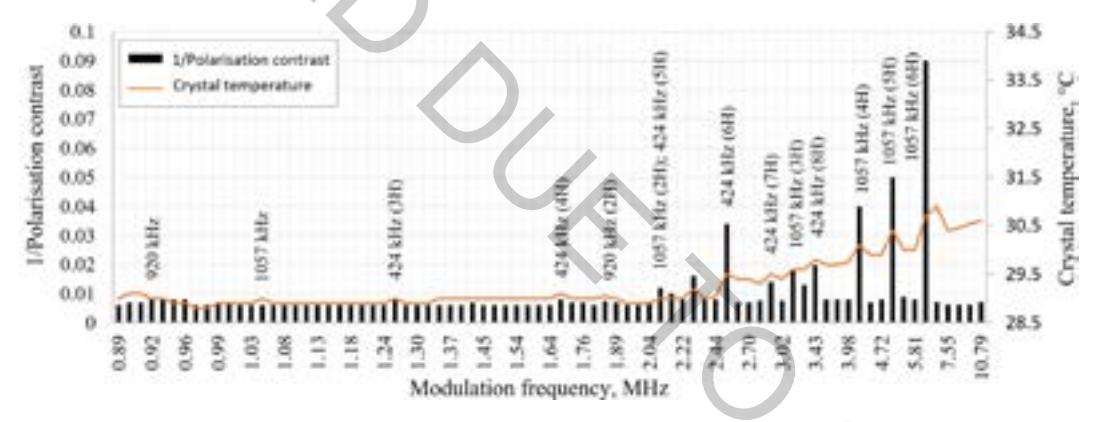
It was found that most of the resonant frequencies can be grouped as the harmonics of three theoretically calculated fundamental natural frequencies of the crystal (424 kHz, 920 kHz, 1057 kHz). The behaviour and dominant mechanism behind the effects of piezoelectric ringing were found to be distinct in the three following modulation frequency ranges:
For resonant modulation frequencies up to 2 MHz, the effect of standing acoustic wave in the crystal was seen as a harmonic wave of PC reduction in the modulated pulse-train. It was concluded that in this modulation frequency range, depolarisation mechanism is dominated by the photoelastic effect.
For modulation frequencies above 2 MHz, crystal surface temperature was found to be increasing by $~0.2$ °C/MHz. This steady temperature gain did not affect the PC at non-resonant modulation frequencies due to thermally compensated configuration of the Pockels cell [2]. However, when piezoelectric ringing occurred, an additional temperature gain was observed, which took up to 90 s to stabilise. The effect on the PC in this frequency range was found to be greater and took longer to settle (up to 30 s). It was concluded that in this modulation frequency range, depolarisation mechanism is dominated by thermal gradient formation due to acoustic wave propagation losses in the crystal. These losses are higher for shorter acoustic waves and hence greater PC drop is observed at high resonant modulation frequencies.
Above 6.3 MHz modulation frequency, piezoelectric ringing has not been observed. It was postulated that high frequency acoustic modes are more effectively damped in the adhesive layer holding the crystal to its mount, however, further research is needed to verify this hypothesis.