Holographic security labels are worldwide used and recognized means for anti-counterfeiting applications. A common technology for realization of these labels is a dot-matrix hologram [1]. Dot-matrix holograms are usually composed of a two dimensional array of <100 μm sized spots where each spot within itself contains one (or several) diffraction gratings with a defined pitch and orientation, and the entire array is imposed on a reflective surface. The working principle of this type of hologram can be explained using conical diffraction formalism [2, 3]. It is a type of diffraction that occurs when the light incident on a diffraction grating is not perpendicular to the grooves of the diffraction grating. Selection of correct diffraction grating parameters for each hologram pixel is of paramount importance for designing such holograms. The appearance of dot-matrix holograms can be precisely modelled once their structure is given along with illumination and observation conditions [3]. Moreover, the true-color hologram appearance could be obtained that is not achievable with any digital printing technique.
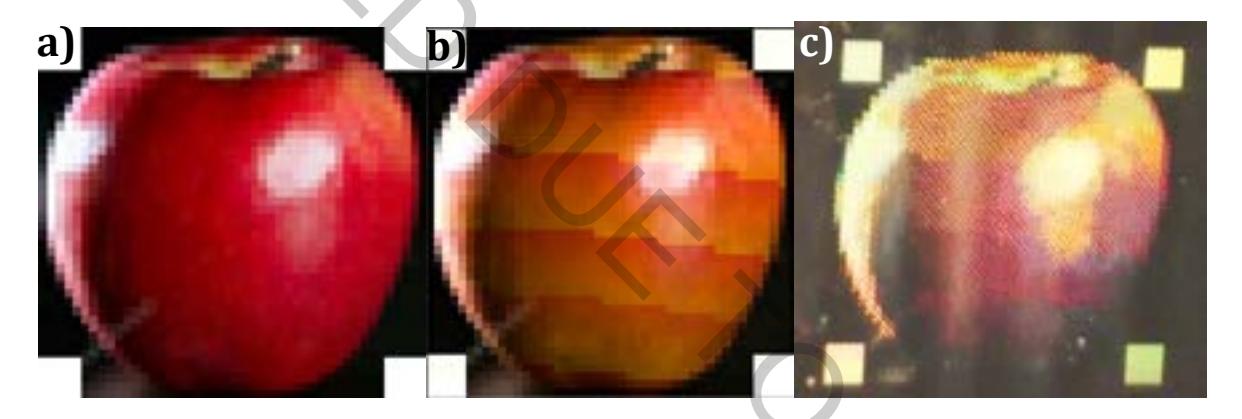
This work explores determination of the dot-matrix hologram parameters necessary to ensure that the hologram originated via direct femtosecond laser interference patterning would look exactly as the selected colored object in the digital image. The proposed algorithm considers the parameters of the target hologram image itself along with its illumination and observation conditions. Fig. 1 depicts a digital image of an apple (a), rendered hologram diffraction image (b) and an actual hologram image captured with a digital camera (c). Spectral characteristics and the overall quality of the reconstructed images were evaluated.