Solid-state lightning has become one of the most widely used lightning options in the world. Applications that require high power density and directional beams could employ laser diodes (LD) [1]. The high light output power which exceeds that of LEDs at high current densities, are the main factors determining the future applications of LDs [2]. LEDs and LDs use phosphors to produce white light. The properties of phosphors have a large influence on the spectral characteristics of the output light. Therefore, the investigation and improvement of phosphors optical and thermal properties is one of the key points in increasing the integration of solid-state lighting in all aspects of our lives. One of the main physical properties of phosphor is photoluminescence quantum efficiency (QE).
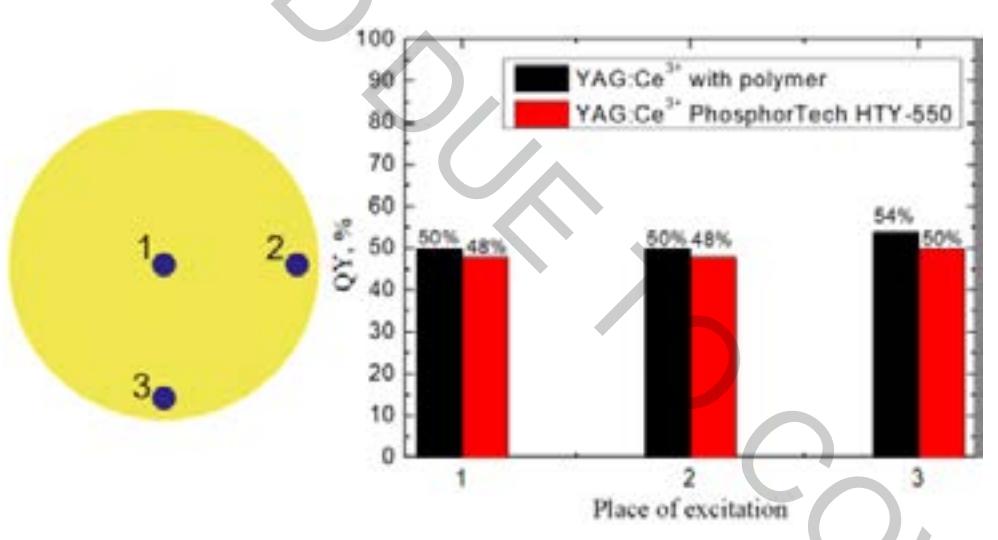
In this work, four different condition phosphor samples were investigated: Y3Al5O12:Ce3+ (YAG:Ce3+) powder synthesized in the laboratory, YAG:Ce3+ with polymer in silicone, YAG:Ce3+ (PhosphorTech HTY-550) in silicone and Eu doped silicate (Intematix EG3261) powder. After measuring the QE of all samples, it was observed that the excitation site in the case of phosphor powder influenced the value of QE. For example, excitation of the powder at high concentrations results in about 20% reduction in QE. The experiment compared QE of commercial phosphor and a phosphor mixed with a polymer. After analyzing the results, a tendency was observed that the phosphor converter with polymer had slightly higher QE compared to the commercial (Fig. 1). Higher QE values are likely to be caused by the phosphor grain surface defect reduction.