
The Shockley-Queisser theory puts the limits on efficiency of a single-junction solar cell [1]. It assumes that only photons having energy close to a semiconductor forbidden energy gap are used effectively in the formation of an electrical output signal. Residual extra energy of the high energy photons not used for the electron-hole generation is scored up only through the process of carrier thermalization, i.e. through the lattice heating, and this way influencing solar cell efficiency. Low energy photons are assumed to be not absorbed at all.
We present experimental results demonstrating direct impact of the hot carriers on photoresponse of a p-n junction. As an object of investigation, GaAs p-n-junction was illuminated with 15 ns-long laser pulses of 1.06 μm wavelength. Short enough pulse and the wavelength opened possibility to observe the induced photoresponse consisting of three components. The first one, $U_G$, is a relatively slow component caused by a classical electron-hole pair generation. The second one, $U_{HC}$, is fast, follows the laser pulse shape and has opposite polarity; this is an inherent feature of the hot carrier photovoltage. The third one, $U_T$, has the same polarity as $U_{HC}$ but is much slower; it is attributed to the thermoelectric electromotive force caused by the p-n junction heating. As the research reveals, each component has characteristic different dependency on laser intensity, applies bias voltage (see Fig. 1), sample temperature.
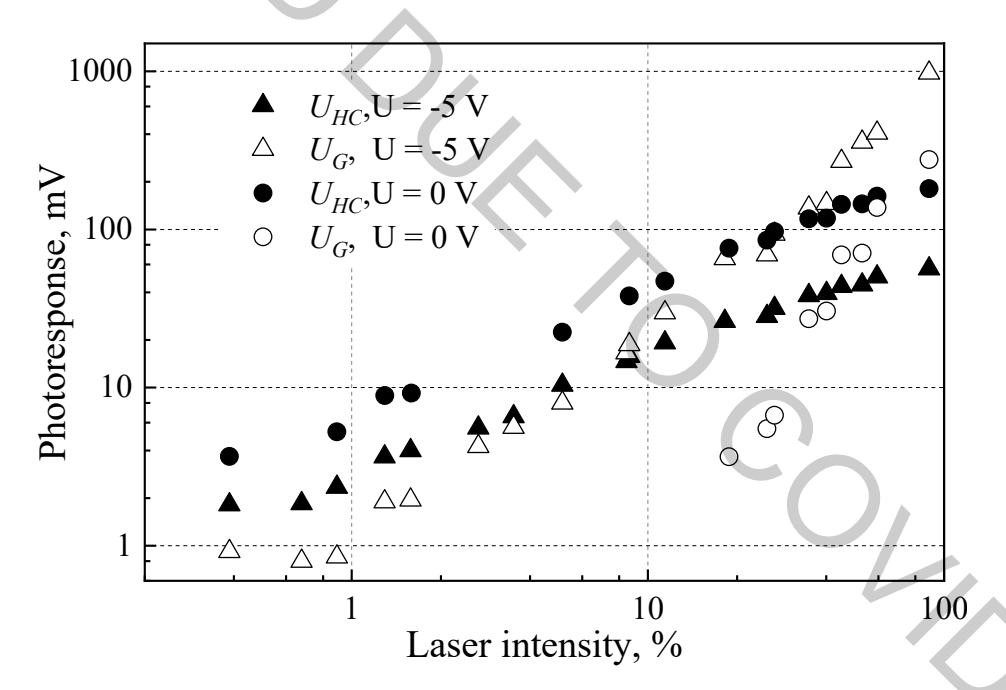
Thus, besides the usually considered thermalization of hot carriers, the magnitude of the net photoresponse depends on the result of mutual simultaneous competition between all three components. Maximum reduction of the hot carrier photovoltage contribution will boost the efficiency of a p-n junction solar cell. On the other hand, reckoning in the direct impact of the hot carriers may possibly lower the theoretical efficiency limit.