
Clinicians are particularly interested in drugs that improve the repair and regeneration of damaged tissues and / or tissues that are deficient in sufficient nutrients, such as Actovegin (Takeda Austria GmbH (Austria) and Solcoseryl (MEDA Pharma GmbH & Co. KG) The active substance, deproteinized calf blood hemoderivative (DCBH), is a mixture of natural substances such as inorganic electrolytes – chlorides, sodium, potassium, calcium, magnesium ions, nitrogen compounds and organic substances – glucose, acetates, lactates, amino acids, peptides, nucleosides, glycosphingolipids, and other metabolic products [1]. The studies of the neuroprotective effect of the drug based on deproteinized hemoderivative in vitro in cultured primary rat hippocampus neurons have confirmed the ability of the drug to exhibit neuroprotective and regenerative effects [2].
The raw material for obtaining the active substance of the drugs is cattle blood, which is subjected to deproteinization after preliminary treatment. The stages of the technological process for obtaining these drugs are not described in detail and differ depending on the manufacturers. Despite a sufficient number of cattle, Ukraine does not have its own technology for the production of DCBH. According to the results of the literature analysis, the technology for producing DCBH consists of the following stages: 1) blood defibrinization; 2) precipitation of high molecular weight proteins with various solvents (ethyl alcohol, acetone) or the breakdown of high molecular weight proteins by acid, alkaline or enzymatic hydrolysis; 3) prefiltration (0.45 μm); 4) sterilizing filtration (0.22 μm); 5) ultrafiltration (cut-off of the 5kDa fraction) [3-5].
The technological aspects of obtaining DCBH for the purpose of further industrial production have been studied. At the first stage of our research, blood was taken from the jugular vein of 2-month-old calves; the blood was defibrated for 6 hours in a thermal room at the temperature of 37°C. Defibrinated blood was subjected to hemolysis by means of a temperature difference: the blood was frozen at the temperature of -40°C for 12 hours and then the blood was incubated in water bath at the temperature of 37°C for 15 minutes, and then the temperature was raised up to 50°C and kept for 50 minutes. Hemolized blood was centrifuged at 5000 rpm for 1 hour. To determine the composition, the obtained intermediate was fractionated by gel filtration on a Sephadex column. The samples containing low molecular weight fractions were studied spectrophotometrically in the wavelength range from 100 to 750 nm in quartz cuvettes of 10 mm thickness (Fig. 1).
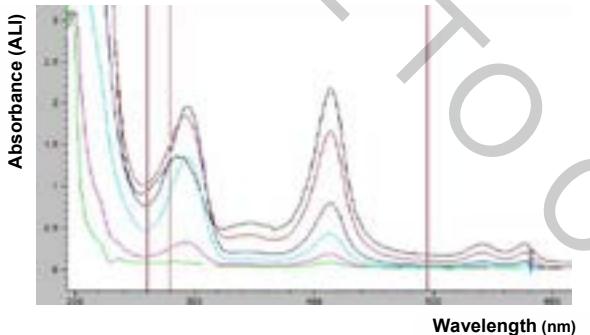
Analysis of the spectrum showed that the absorption maxima at the wavelength of 280 nm are based on the presence of tyrosine and tryptophan aromatic amino acid residues in the protein composition. Optical absorption at the wavelength of 405 nm indicates the presence of α-Amylase, alkaline phosphatase, and cholinesterase. Optical absorption at the wavelengths of 540 and 570 nm is due to the presence of hemoglobin.
Thus, a deproteinized calf blood derivative has been obtained for the subsequent studies of its low molecular weight fractions.