
Miniaturization of photonic devices based on novel functional materials is one of the emerging streams of nanophotonics [1]. Organic materials are rather perspective here since they provide relatively high exciton binding energy, strong charge-transfer mediated photoluminescence (PL), efficient optical nonlinearity, tunable optical band gap and flexible device shapes compared to inorganic ones. Organic microresonators attract much attention, because they can be used in microlasers with very low excitation threshold and in sensoric applications due to strong dependence of resonant properties of cavity modes on ambient conditions. One of the most promissing methods of such microstructures fabrication is self-assembly [2]. By varying organic compound type, solvent, solution concentration and evaporation conditions structures with various shape such as spheres [2], hemispheres [2], rods [2] and so on can be obtained. It is well known that these structures can exhibit Fabry-Perot (FP) and whispering gallery (WG) cavity modes which increase field localization and lead to significant amplification of nonlinearoptical processes.
Here, 1,1'-bi-2-naphthol (Binol) is one of perspective materials capable for the formation of microspheres via self-assembling. WGMs were recently demonstrated in the single-photon PL spectrum of such structures for both enantiomers. At the same time, up to now, nonlinear-optical properties of single and coupled binol microspheres, as well as the effects accompanying multiphoton excited WGMs in them have not been studied.
For the nonlinear-optical measurements, we used the home-made multiphoton microscopy setup based on a Ti-sapphire laser (pulse duration 60 fs, repetition rate 80 MHz, mean power 3-200 mW, wavelength range = 720-890 nm) and Ytterbium-doped laser (pulse duration 200 fs, repetition rate 80 MHz, mean power 0.01-4 W, wavelength = 1050 nm) equipped with focusing and collecting objectives with NA = 0.7, which allowed to focus laser radiation in a spot with a diameter of 1 μm. The photomultiplier operating in the photon counting mode and spectrometer with a spectral resolution of 1 nm were used to detect scattered nonlinear signal.
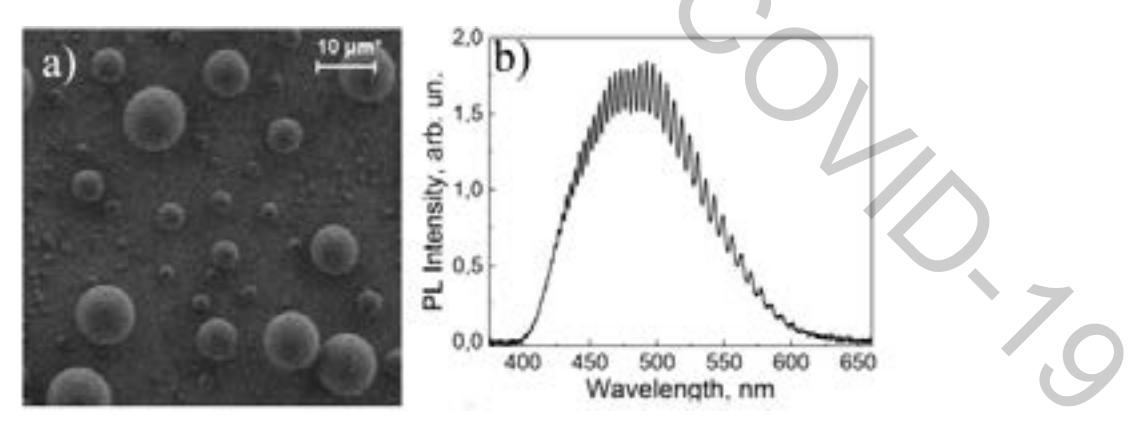
Our studies were focused on the effective multiphoton excitation of WGMs in microspheres based on Binol (fig.1a). Microstructures shows intensive two- and three-photon photoluminescence (2PL and 3PL). Fig. 1b shows a typical 2PL spectrum of a single microsphere with narrow peaks associated with WGMs. Binol is a chiral organic compound, and it responds to left and right circular pump polarizations in different way. To study the chirality driven nonlinear optical effects in binol microspheres, we used Z-scan technique that we adapted for single microstructure measurements. It allowed us to estimate two- and three-photon absorption coefficients, for two circular pump polarizations and nonlinear circular dichroism. Its values are equals to 7.7% for two-photon response and 11% for three-photon. The self-assembly method allows for the formation of more complex microstructures such as dimers, trimers etc, which allows one to study the coupling effects in their nonlinear WGM spectra.
These results make these WGM microresonators perfect candidates for the development of polarizationsensitive nonlinear-optical sensors and nanophotonic devices working with chirality-dependent signal.