
The spontaneous atomic ordering in the conventional $A^{III}(B_{1-x}C_x)^V$ [or $(A_{1-x}B_x)^{III}C^V$] semiconductor alloys was discovered in the late 1980s [1]. Usually, the ordering is of the CuPtB type, when elements of the V (or III) group arrange themselves in alternating $(\bar{1}11)$ or $(1\bar{1}1)$ planes. The ordering induces changes in the electronic structure of alloys and, therefore, their optical properties.
Recently, the CuPtB ordering was reported for GaAsBi bismides [2]. However, no optical studies of the ordering-induced optical properties of bismides have been carried out so far.
In this work, photomodulated transmittance (PT) and Mueller matrix ellipsometry techniques were used to investigate the optical anisotropy of GaAsBi induced by the atomic ordering. GaAsBi sample with 3.86% bismuth concentration was grown by molecular beam epitaxy on a semi-insulating (001) GaAs substrate. Figure 1(a) presents PT spectra measured at different polarizations of the incident light beam. The spectra show a distinct polarization dependence of two optical features, positioned at 1.122 eV and 1.179 eV, which correspond to valence band splitting $\Delta_c = 57$ meV. The polarization dependence is determined by the $[1\bar{1}0]$ direction, which is a projection of the atomic ordering axis $[1\bar{1}1]$ to the sample surface.
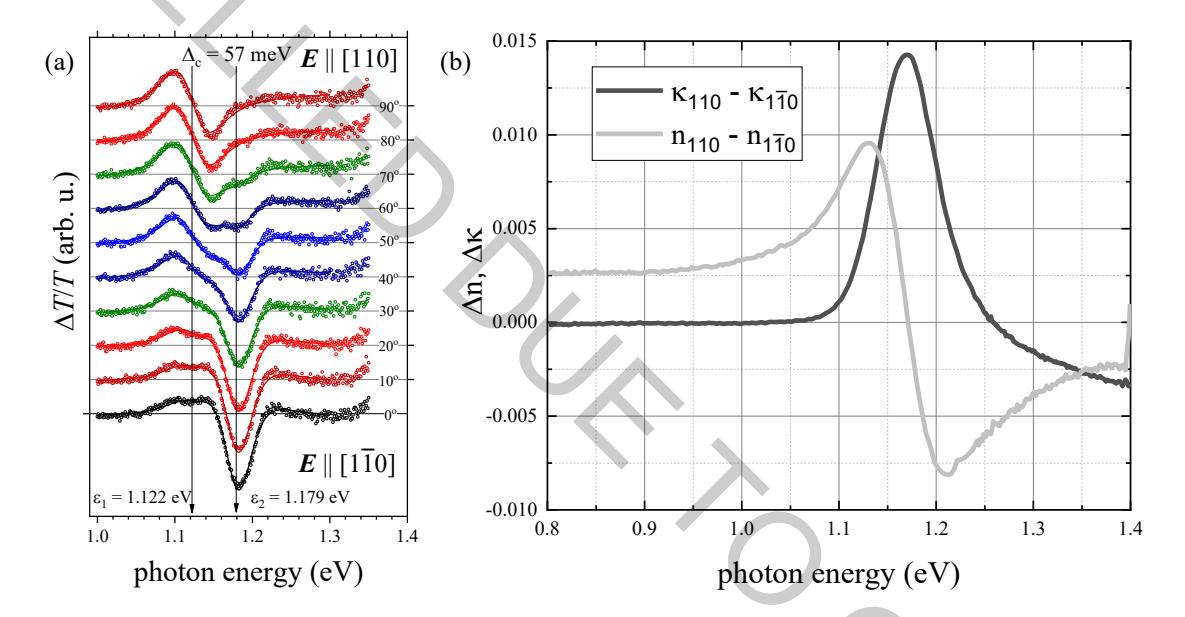
Figure 1(b) presents results of ellipsometric measurements in transmission geometry. Making use of the Mueller matrix analytic inversion method [3], the linear birefringence and dichroism (along [110] and $[1\bar{1}0]$ directions) spectra were determined. The sample is clearly anisotropic with its optical axis parallel to the atomic ordering $[1\bar{1}1]$ (or $[1\bar{1}1]$) direction. The highest birefringence value reached 0.0097 at 1.13 eV and the dichroism peaked at 1.17 eV with a value of 0.0144. Another characteristic tail is seen above 1.25 eV, however this feature is hidden behind GaAs absorption.
The optical anisotropy of GaAsBi observed both in polarized transmittance and ellipsometric spectra is induced by spontaneous CuPtB-type atomic ordering of bismuth atoms.