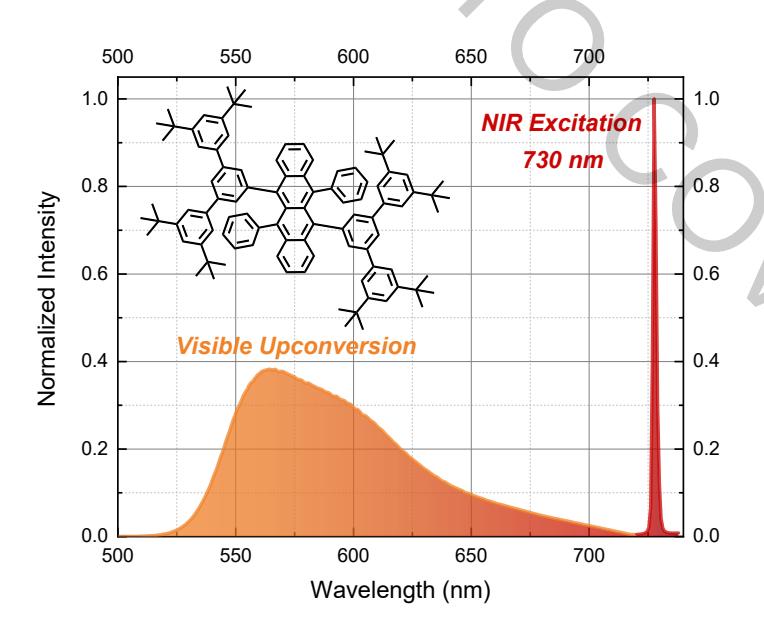
Triplet-triplet annihilation (TTA) mediated NIR-to-visible photon upconversion (UC) has made a significant breakthrough in the field of photonics in recent years. [1] TTA-UC has promising applications in photovoltaic, photocatalysis, night vision and bio-imaging devices, among others. [2] UC systems are typically composed of a sensitizer and emitter. Sensitizer is responsible for absorption and triplet generation whereas emitter accumulates triplets and undergoes TTA. However, several challenges related to poor sensitizer absorption in the NIR range and low UC quantum yield are yet to be overcome. Rubrene (Rub) is widely used emitter (annihilator) in NIR-to-visible UC, although its tendency to aggregate at high concentrations severely limits TTA-UC performance. Thus, alteration of Rub molecular structure to suppress aggregation is one of the prime tasks.
The research focus of this work is laid on the examination of an impact of tert-butyl-phenyl (tbp) moieties on the concentration quenching as well as other photophysical parameters of annihilator for boosting UC quantum yield. To this end, photophysical properties of tbp-Rub emitter including absorption, emission, excited state lifetime and quantum yield were thoroughly assessed. Absorption spectrum of dilute toluene solution ($10^{-5}$ M) of tbp-Rub exhibited vibronic structure with the peaks centered at 463 nm, 492 nm and 527 nm whereas fluorescence (similar to unmodified Rub) was peaking at 560 nm. Fluorescence quantum yield measurements carried out by using integrated sphere have shown that tbp-Rub in the isolated form is nearly 100% efficient. For UC measurements sample solutions and films with different concentration of emitter and phthalocyanine (PdPc) sensitizer in the polystyrene matrix were prepared in nitrogen glovebox (O2 and H2O concentration <0.1 ppm). Furthermore, UC intensity dependence from excitation power density was investigated and the threshold for TTA-UC was estimated to be 40 W/cm2. Being considerably higher as compared to the threshold of unmodified Rub UC system (~2 W/cm2), it demonstrates the negative impact of alkyl moieties in Rub on the performance of UC solutions.
In summary, although the introduction of tbp spacers into Rub enabled to suppress aggregation and enhance fluorescence yield, this substantially increased UC threshold making tbp-Rub emitter less suitable for practical NIR-to-visible UC applications.