
The general objective of this research is non-destructive assessment of the grain size in the metals. The authors propose fresh attempt at applying neural network technology to achieve this goal by application of the neural-network for analysis of the ultrasonic structural noise. It was assumed that the signals of ultrasonic structural noise are measured at several frequencies. To address structural noise issues, a convolutional neural network is designed to process ultrasonic sensor data, to learn structural noise features and to achieve direct grain size estimation simultaneously. To ensure minimum data gathering of metal samples the design focuses on neural network with concept of semantic instance segmentation, for data extrapolation. Experimental results show that proposed methods as semantic instance segmentation with combined convolutional and fully connected dense neural networks with classifiers, outperform the others single neural networks with original samples with high SN data.
This study introduces a new approach to grain size estimation using neural networks with adapted architecture. Proposed feature learning model for metal object grain size prediction shown in Fig. 1.
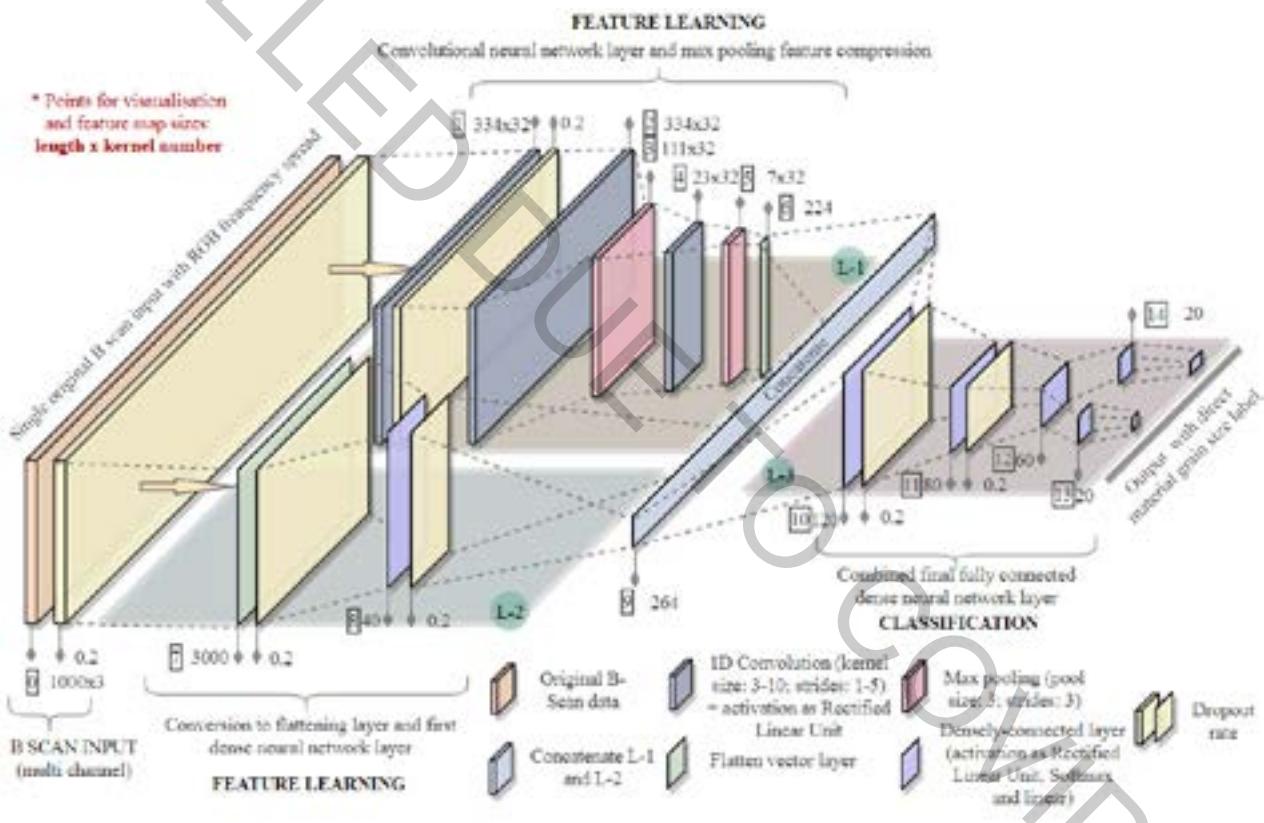
To solve grain size estimation problem, this presentation will provide visualization of hidden layers in the network by maximizing the activation of the target layer on the input. The final neural layers of the network which plays a big role as band-pass filters that focus on the structure's natural frequencies. Multi-band filters which can be found in the middle layers. Learning process that the network has independently learned the concept of structural mode.