
Diamond like amorphous carbon (DLC) thin films are universally used as a protective layer in: optics, medical industry, electro-mechanical devices and elsewhere. It is well known that amorphous carbon consists of sp3 and sp2 bonds. Diamond-like properties are achieved when sp3 bonds are dominant in the thin film, while sp2 bonds are responsible for graphite-like properties. Therefore, sp3/sp2 ratio determines the characteristics of amorphous carbon layer. Differentiation between distinct properties and the optimal magnetron sputtering deposition parameters (working pressure, temperature, bias voltage, sputtering current/power) for film growth proves to be immensely pragmatic. Extensive research has been conducted on DLC's [1], nonetheless the substrate bias dependence on optical properties is yet to be thoroughly evaluated. There are some disagreement on the substrate bias voltage influence on carbon film deposition rate [2, 3]. Thus, the aim of this research was to determine the substrate bias voltage effect on growth rate and optical properties of DLC films.
n- type silicon wafers (1 cm x 1 cm) and glass substrates (1 cm x 2 cm) were coated using magnetron sputtering. Films were grown for 40 minutes, while the working pressure was held constant at 2 Pa. Discharge current was: 0,5 A, 1 A, 1,5 A, substrate bias: 0 V, -50 V, -100 V and -200 V. Every possible combination was analyzed, in total producing 12 unique series. The temperature of the substrate at the end of the sputtering process was monitored using thermocouple, along with substrate ion current. In addition, ellipsometer, micro-interferometer and UV-vis were utilized to analyze the complex reflective index, the transmittance and thickness of the aforementioned films.
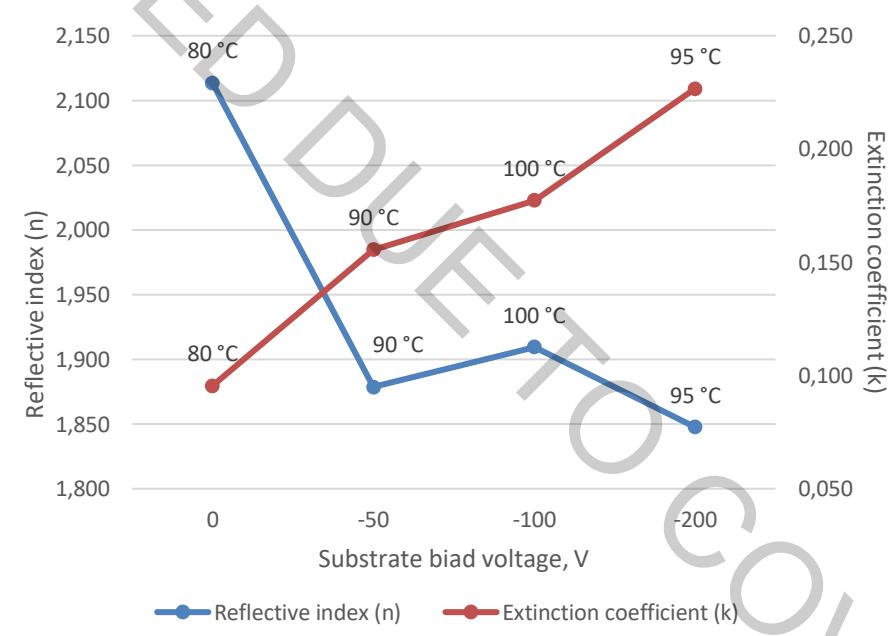
After methodical measurements it was noticed that by lowering substrate bias and increasing discharge current the reflective index deteriorate from 2,11 to 1,66, extinction coefficient went up from 0,10 to 0,49, while transmittance subsided. Furthermore, the film thickness escalated from 150,08 nm to 552,86 nm, consequently affecting the growth rate from 3,75 to 13,82 nm/min. The substrate bias changing from 0 V to -200 V enhanced the ion bombardment, hence increasing the substrate temperature and reconstructing sp3 to sp2 bonds and causing graphitization of the films.