
Usually bacteria prefer to live in the communities called biofilms. They could be found in industrial places, food facilities, water systems, hospitals and, also in spacecrafts.[1] It is known that biofilms are much more resistant to physical and chemical treatments, including antibiotics. Their resistance to antibiotics is an enormous problem in the world. Therefore, the development of alternative technologies could help to solve this problem. The one of promising approaches to treat biofilms is the use an antimicrobial photoinactivation (API). API is a modern biophotonic technology involving the employment of the photosensitizers (PS) that selectively accumulates in the target cells which are then illuminated. The interaction of PS and light, in the presence of oxygen results in a plethora of cytotoxic reactions and consequently, induces selective destruction of the target microorganism [2]. The efficacy of API is influenced by many factors but especially by physical and chemical properties of the PSs. For spacecraft applications it is necessary to use PSs which are chemically pure and water-soluble, with a stable shelf-life, not bleaching and easy to produce. This study focuses on natural PSs.
The first used PS was riboflavin (vitamin B2) (Fig. 1a) which plays an important role in the cell metabolism process and can be considered safe when administered to humans [3]. RF crystals have a yellow-orange color, whereas neutral solutions of RB have a green color. This is why they are used as the food coloring known as E101. Also, RF has been generally known to have antimicrobial properties. It is heat-stable but easily degraded by light, especially to UV irradiation. Therefore, light-induced activation of RF can selectively damage pathogen [4]. Although this PS belongs to the group of water-soluble vitamins it is, in fact, one of the least soluble in water (12 mg/100 mL at 25 °C).
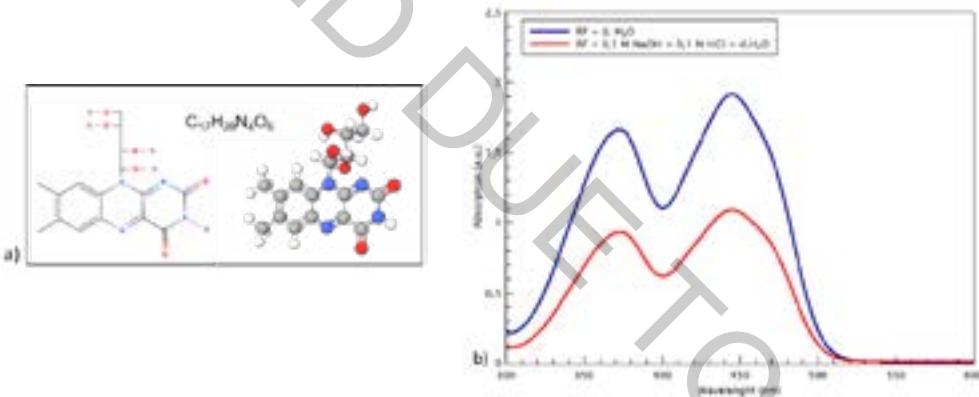
In the first stages of this work, we have prepared the aqueous solution of stock RF (concentration $10^{-4}$). It was used two dissolution ways: 1) RF was agitated in distilled water (d. H2O) on a magnetic stirrer at temperature 25 °C in the dark (pH~7); 2) RF was dissolved in the dark in a solution of 0,1 M NaOH, 0,1 M HCl and d H2O (pH~7.2). The final analyzed concentrations of RF in both cases were from $10^{-6}$ to $10^{-4}$. It is known that RF absorbance spectra have four maximums: 223, 267, 373, 444 nm [5]. We choose absorbance window from 300 nm till 600 nm because we were interested only in two peaks: 373 and 444 nm. The absorption measurements were recorded using a Perkin Elmer, Lambda 950, UV-Vis spectrometer at a spectral resolution of 0,05 nm. The concentration dependence of the absorption spectra of both RF solutions was investigated in this region. Unfortunately, $10^{-6}$ M concentration of RF was too low to obtain significant absorption results. However, at $10^{-4}$ M concentration in the first solution (dissolved in d. H2O) RF molecules had about two times higher absorptions than in the second solution (dissolved in 0,1 M NaOH, 0,1 M HCl, d. H2O) (Fig. 1b). Furthermore fluorescence and absorption spectra of RF in different buffers were measured, because their concentration and ionic strength have an important role in the photodegradation of RF in aqueous solution[5]. Along with the spectral-luminescence measurements, thermostability of PSs was analyzed. In conclusion we show that riboflavin is a promising candidate to be used as natural photosensitizer in spacecraft applications, but further investigation has to be performed.