Glass was proven to be material of choice in multitude of rapidly developed science and engineering fileds. Popularity of this material arises from its superb mechanical properties, being completely transparent for the visible and near infrared (IR) radiation and being chemically inert in organic solvents. While various glass processing techniques exist, most of them are unable to produce required 3D high-fidelity structures out of glass or it is highly complicated. It is limiting the adoption of 3D glass structures in a lot of areas.
One the most promising technology to produce 3D glass structures is selective laser etching (SLE) [1]. Potentially, many types of glasses and crystals can be processed this way. Nevertheless, this process is not exploited widely. The problem lies in the complex nature of light-matter interaction and challenges in optimising the technique for true 3D fabrication. Laser parameters, translation velocity, etchant concentration and etching time are all important factors that cannot be disregarded [2,3]. Thus, overall, while the premise of SLE is simple, so far realisation was proven to be rather complicated.
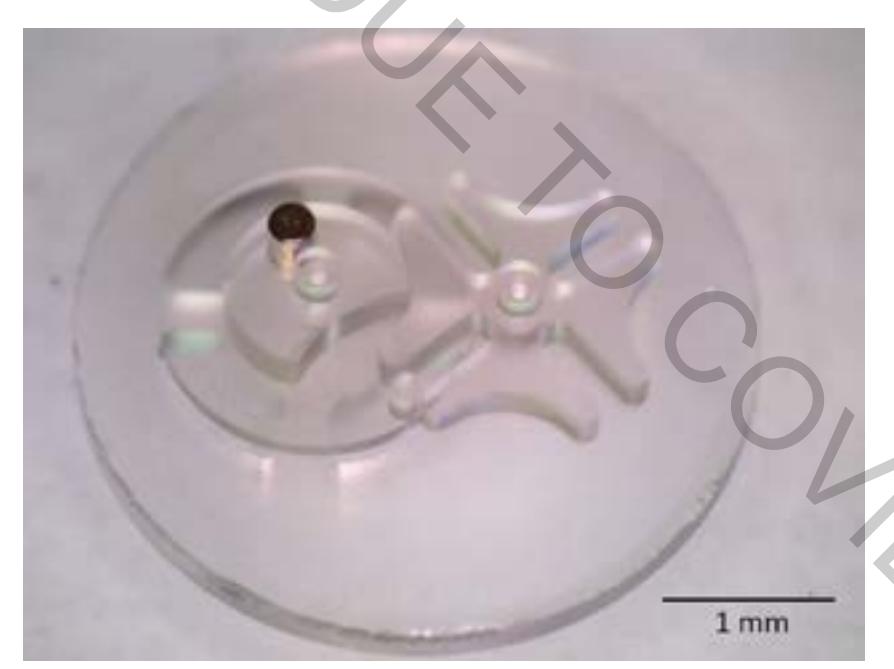
The aim of this work is to uncover the ways to simplify the production methodology of SLE while still maintaining good quality. The improvements of the technique include adoption of circular polarization, high scanning speed (a few cm/s), KOH etching and high-spacing between scaning lines in all space directions which in turn both simplify and accelerate the processing. The methods are employed to manufacture complex microfluidic systems and assembly-free micromechanical structures. These include various channels, deformable 3D objects, chainmail-like structures, flexible structures with ball joints, and freely rotatable gears (e.g. Geneva mechanism) (fig. 1). All of these structures are evaluated qualitatively and quantitatively showing that simplified fabrication techniques do not compromise quality or functionality of the structures. The smooth rotation of the mechanism is enabled by capability to produce such glass structures with a few μm tolerances. The acquired results are shown in the broader picture, relating it to previous SLE works, additive manufacturing and potential application areas.