
It is well known that thiocarbonyl compounds such as aryl, hetaryl or cycloaliphatic thioketones ($R_2C=S$) are important building blocks, widely applied for preparation of sulfur heterocycles with diverse ring size. Their superior ability to react with 1,3-dipoles or dienes via the C=S group brought them into prominence as 'superdipolarophiles' and 'superdienophiles' in [3+2] and [4+2] cycloadditions reactions, respectively [1,2]. Sulfurization of the C=S bond leads to so called "thiosulfines” (thiocarbonyl S-sulfides). They are considered as a class of elusive 1,3-dipoles that in situ undergo further conversions. The evidence of their supposed existence was unambiguously demonstrated in 1987 by R. Huisgen and J. Rapp [3-5]. The sulfur transfer reaction involving elemental sulfur ($S_8$) as a sulfur source, require its activation via homolytic or heterolytic cleavage of the S-S bond. Various chemical species are known to activate the $S_8$ ring, however one of the unorthodox but only little-known approaches is the usage of the fluoride anion F- as a catalyst.
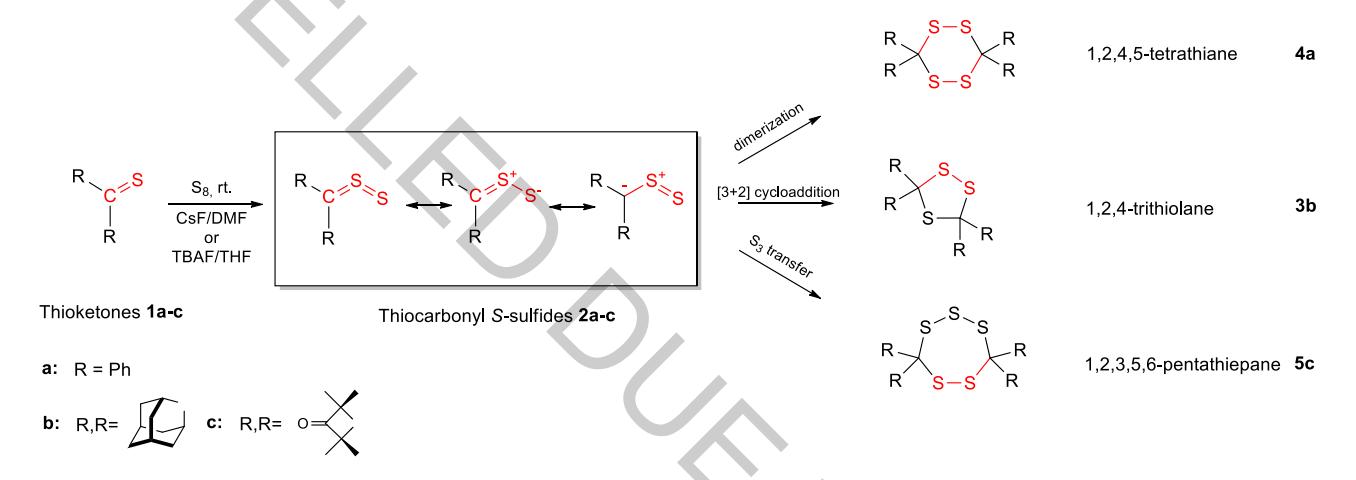
In our ongoing research, we found that sulfurization of aryl and cycloaliphatic thioketones 1a-c by treatment with elemental sulfur ($S_8$) in the presence of cat. amounts of fluoride anion (cesium fluoride (CsF) or tetra-n-butyl ammonium fluoride (TBAF)), leads to formation of thiocarbonyl S-sulfides 2a-c that in situ undergo further conversations. We also found that, depending on thioketone type, the product can be formed as 5-, 6- or 7-membered heterocyclic ring with four (1,2,4,5-tetrathiane) 4a, three (1,2,4-trithiolanes) 3b, or five (1,2,3,5,6-pentathiepanes) 5c sulfur atoms. A novel, unique and efficient method for the S-transfer to the C=S bond via activation of $S_8$ with fluoride anion as well as mechanisms of the formation of sulfur rich heterocycles 3-5 will be discussed.