
Solid oxides, characterized by high ion conductivity in intermediate temperature range (500 – 700 °C), are widely investigated for potential application in fuel cells, gas detectors or gas-separating membranes. One of such materials is bismuth (III) oxide, particularly in $\delta$-Bi2O3 phase, which demonstrates the highest known oside ion conductivity ≈ 1 S/cm, at temperature > 730 °C. However, delta phase is only stable at narrow temperature range (730 – 830 °C) [1].
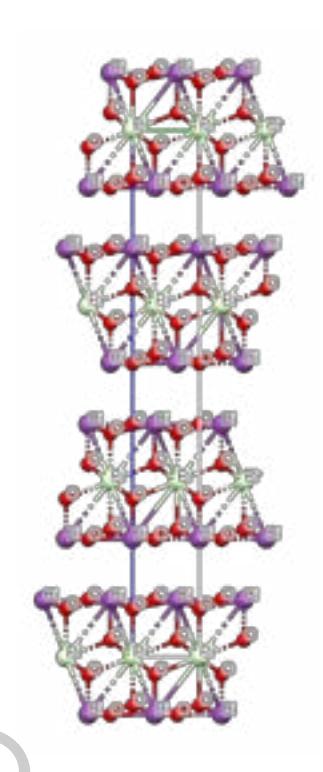
One of the methods for obtaining stable $\delta$-Bi2O3 type phase at lower temperatures is to create solid state solutions of Bi2O3-Ln2O3 system, where Ln is a rare-earth metal. The radius of dopants element may determine the structure of the system. Smaller cations such as, Y3+, Yb3+ help to stabilise fluorite type structure ($\delta$). On the other hand the ones with similar ionic radius e.g. La3+, Pr3+ can lead to formation of rhombohedral structure (schematically shown in fig. 1) instead [3]. What is worth noting, rhombohedral Bi2O3-Ln2O3 systems demonstrate only slightly lower ionic conductivity compared to the fluorite phase, whilst being much more stable during long-term annealing.
Previous investigations of rhombohedral Bi2O3-Pr2O3 systems, has shown that better understanding of structural properties, particularly in the vicinity of $\beta_2 \to \beta_1$ phase transition of order-distorder type at 730 °C, provides us better understanding about stability factors of the studied materials [4]. It is also known that morphology is one of these factors, which may be modified by e.g. various methods of synthesizing those materials. Previous research has proven that using fast cooling from liquid phase techniques, like melt-quenching or twin-rollers, may result in obtaining nanomaterials or composites, of different structural properties than their polycrystalline equivalents with bigger grains [5, 6].
The aim of this work is to obtain a Bi2O3-Pr2O3 system with smaller grain size than in ceramics obtained during previous studies [4]. In particular, our aim was to synthesize glass-ceramic composites, consisting of small grains (below 100nm), confined in glass matrix. Therefore fast-cooling techniques were applied in order to obtain glass-ceramic composites of Bi2O3-Pr2O3. X-Ray diffractometry (XRD) at room temperature (Phillips XPert Pro) was performed to investigate initial structural properties. Temperature dependent XRD measurement (Anton-Paar HTK 1200 Furnace), were conducted to observe thermal stability of as-received samples.