Electronic and photonic industries demand fast and high-quality processing of glasses. Compact lasers, collimators, wave-meters and other compact systems utilize small-sized optical elements, often of a complex design. Such elements can be cut out of the standard 1 or 2-inch optical elements using laser-based technologies, such as direct laser ablation, rear side drilling and crack generation in the bulk of the material. Rear side drilling and crack generation techniques offer highest processing rates but have geometric, processing quality and technological limitations [1, 2]. Therefore, the direct ablation technique seems to be the most versatile, allowing high processing quality and cutting of complex shapes. However, the latter approach suffers from low cutting speeds [3].
Although the new ultra-short pulsed lasers offer high average power at high-pulse repetition rates allowing even faster production, the full laser potential is rarely utilized in glass cutting applications. Energy fluence, scanning speeds, pulse repetition rates and other laser parameters are limited to avoid glass overheating and generation of cracks [4, 5, 6]. Fortunately, studies have shown that laser processing speeds could be significantly increased by introducing a thin flowing water layer onto the surface of the workpiece [7, 8, 9].
In this work, a picosecond laser working at 1064 nm wavelength was used to evaluate the direct laser ablation efficiency and process quality of soda-lime, borosilicate and SF6 glasses in ambient air and water-assisted environments. Efficient ablation of the grooves and complete cutting of glass plates were investigated. Optimal laser parameters for ablation and water supply methods were defined.
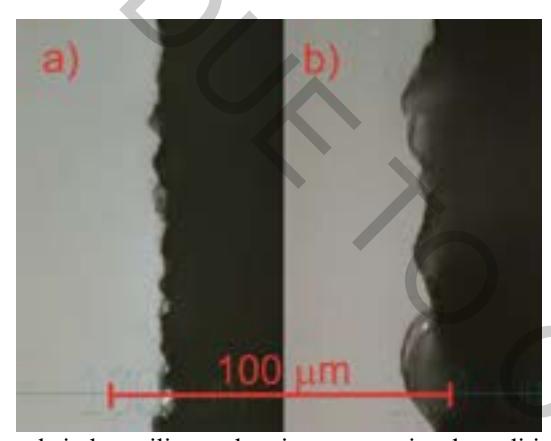
Results revealed the improved ablation efficiency and glass cutting rates when the thin water layer was introduced into the laser ablation area. At optimal conditions, the glass ablation efficiency was improved 6-fold, reaching 0.18 mm3/min/W, compared to the ablation in ambient air. Furthermore, the applied water layer reduced both the edge roughness and the chipping of glass material at the edges of the grooves (see Figure 1). Finally, optimal parameters were used to cut out optical elements of 5 mm in diameter out of the 1 mm thick mirror-coated optical glass at a cutting rate of 0.22 mm/s.