
We offered a lattice distortion model [1] which describes the complex behavior of atomic systems aligned by different spatial angles in neighbor microstructures. Poisson's ratio value of crystalline material $v_{sim}$ can be simulated without doing any experiment and expressed as average value of all groups' of materials lattices oriented at different angles interacting together during l number of peaks:
$$v_{sim} = \frac{1}{l} \left( \frac{1}{l} \sum_{k=1}^{l} v_{\max k} + \frac{1}{l-1} \sum_{k=2}^{l} v_{\max k} + \dots + v_{\max l} \right); \tag{1}$$where $v = \frac{1}{N} \sum_{i=1}^{N} \sum_{j=1}^{n} \frac{v_{j}}{n}$ is Poisson's ratio values of n lattices' groups interacting together, $v_{j} = -\frac{\varepsilon_{yj}}{\varepsilon_{xj}}$ is Poisson's ratio values of j group of lattices in the model, N is number of interactions in model, $\varepsilon_{xj}(d_{xj}, \alpha_{xj}, C)$ and $\varepsilon_{yj}(d_{yj}, \alpha_{yj})$ is longitudinal and transverse deformation, C is coefficient of deformation intensity $1/\xi \le C \le 1/\xi^2$ while $\xi$ is parameter which shows an intensity of one atom inertia to another according to the movement direction and depends on deformation level $(0 < \xi \le 1)$.
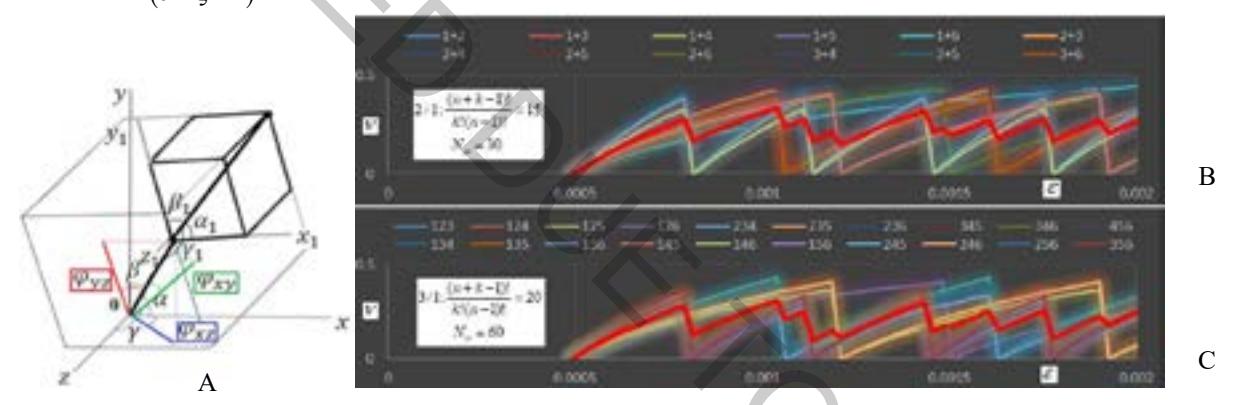
Some corrections of this model can be done by evaluating the electron sublayers configuration in the lattice:
$$\mathbf{v} = \mathbf{v}_{sim} \cdot \left( 1 + f_1 \left( \frac{\sum x}{\sum Y} \right) \right); \tag{2}$$where $v_{sim}$ is simulated Poisson's ratio value according to the equation (1), $f_1$ is weight function, $\sum x$ is sum of electrons in atom sublayers by their filling and $\sum Y$ is sum of electrons in the sublayer to be filled.
The model improvement from the perspective of sublayer filling by electrons increased proximity of simulated Poisson's ratio values to experimental by 53 %. In present study, the multiparametric atomistic model of crystalline materials is shown as a maturing and perspective tool in solid state physics and materials science. It can be used for the fine investigations of atomic states descriptive elastic characteristics of solid and comprehensive transformational evolution between differently aligned atomic systems and neighbor grains of microstructure. For the quantitative analysis, further studies are directed to creation of exact models for other crystalline materials having BCC-lattice.