Low electronic conductivity of cathode materials for the next generation of Li-ion batteries is a serious factor limiting their electrochemical performance. Thermal nanocrystallization of glassy analogues of selected cathode materials for Li-ion batteries is a powerful but relatively simple method to prepare highly-conducting nanomaterials. In previous paper [1], properties of nanocrystallised LiFePO4 with small amounts of vanadium, prepared with this method, were described. Vanadium was used to facilitate glass formation of priscine samples. Subsequently, the research was carried out to prepare and explore properties of nanocrystallised LiFePO4 without addition of vanadium, and the preliminary results of this research are presented here.
Objective of this paper was to develop the idea of thermal nanocrystallisation through systematic research on optimal conditions of obtaining amorphous LiFePO4. Syntheses of samples were carried out with twin rollers method [2] and with different process conditions. After synthesis, samples were analysed with differential thermal analysis (identify temperature of glass transition and temperature of crystallization), X-ray diffractometry (verify amorphousness of samples and study process of (nano)crystallization) and impedance spectroscopy (determine electrical conductivity).
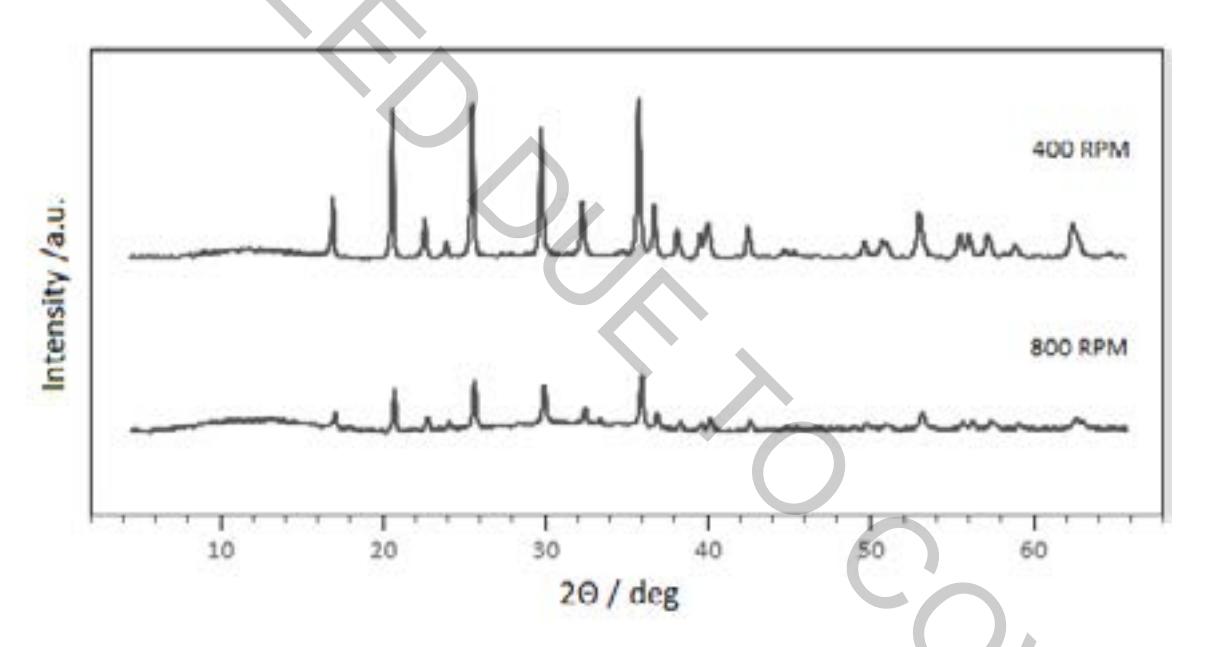
First results of X-ray diffractometry (Fig. 1) showed that different conditions of synthesis (i.e. rotation speed of the rollers) has effect of content of amorphous phase in samples.