Nowadays energy storage is based primarily on lithium ion batteries as Li-ion cells power everything from mobile phones to electric cars. However, the increased demand causes natural problems of increasing prices of lithium resources as well as concerns about long-term availability. One of the emerging alternatives is batteries based on sodium, which is highly abundant and cheap as well as having a redox potential only 0.3 V above of its lithium counterpart, thus a small energy loss for a cheaper alternative [1]. In recent years NASICON structures became highly investigated because of their vast ionic channels, structural stability, and the great number of sodium insertion sites. A general formula for NASICON is $A_xM_y(XO_4)_3$, in which A represents an alkali metal, M generally is a transition metal and X is a nonmetal atom, while the structure of crystalline phase is a polyanionic compound having $MO_6$ octahedras and $XO_4$ tetrahedras with vast amount of channels in between them making it possible for a quick alkali ion diffusion. Recently a new type of NASICON compound $Na_3MnTi(PO_4)_3$ (NMTP) became attractive as it contains electrochemically active $Mn^{2+}$ and $Ti^{4+}$ ions, allowing to construct a symmetric battery, as it can be used as both anode and cathode. Another huge advantage of this type of electrode is its theoretical oxidation reduction potential range, which is in the range of potential of either oxygen or hydrogen evolution from water, thus giving viability to use it in aqueous solution, further lowering cost and improving safety of NMTP symmetrical battery [2].
The aim of this work is to investigate NASICON structured $Na_{2x}Ti_{2-x}Mn_x(PO_4)_3$ phase formation depending on the different amounts of manganese using sol-gel method for synthesis, conjointly investigating structural properties and electrochemical behavior of the synthesized powders.
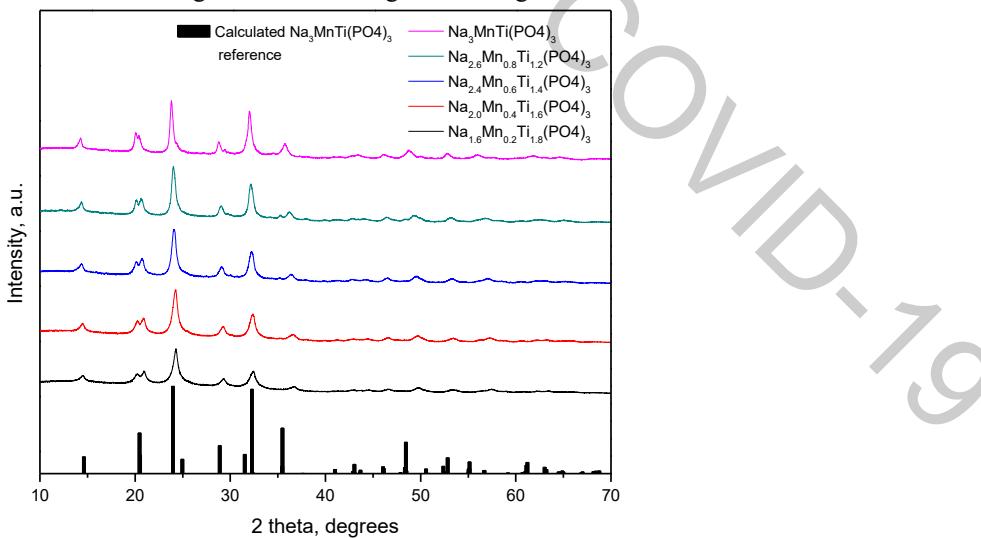
The synthesis of NASICON $Na_{2x}Ti_{2-x}Mn_x(PO_4)_3$,was made using modified sol-gel method employed by by Goodenough et al. [2]. The Sol-gel procedure involved mixing manganese acetate tetrahydrate, sodium acetate, citric acid, ammonium dihydrogen phosphate and dihyroxybis(ammonium lactato)titanium(IV) in aqueous medium. The obtained sol was dried at 100 °C. However, owing to some possible strains of crystal lattice it was not entirely possible to obtain completely pure NASICON $Na_3MnTi(PO_4)_3$, therefore an investigation of manganese insertion into NASICON $Na_2Ti(PO_4)_3$ crystal lattice was made by varying manganese amounts from 0 to 1 in final $Na_{2x}Ti_{2-x}Mn_x(PO_4)_3$ structure and calcining obtained sols in temperature ranges varying from 600 °C to 700 °C in order to attain optimal phase formation temperature of each composition. Obtained powders structure was investigated by x-ray diffractometer (XRD), size of obtained particles was characterized by scanning electron microscope (SEM). The optimal temperature for NMTP phase formation in $Na_3MnTi(PO_4)_3$ was researched to be 600 °C, which increases with decrease of manganese amount to a temperature of 700 °C in $Na_{1.4}Mn_{0.2}Ti_{1.8}(PO_4)_3$.
Furthermore, the next phase in this research will be analyzing electrochemical behavior of NMTP powders by casting electrodes and performing cyclovoltammetric and galvanostatic charge – discharge scans.