
In recent decades laser has proven to be a versatile tool for cutting, drilling, ablating and micro-processing a variety of engineering materials [1]. Pulsed lasers provide submicrometre precision due to reduced heat diffusion related to fast laser-matter interaction, thus it is great for cutting transparent substrates with coated thin layers on them [2].
In this work we present, to our knowledge, previously little studied phenomena of laser beam causing damage to the back-side coating layer of the transparent media at the large distances from the scribe line (comparing to the laser beam spot-size). While laser scribing 1 mm thick fused silica glass with 30 nm-thick gold layer, ablated area in gold approximately 0.9 mm away and parallel to the laser beam was observed (Fig. 1).
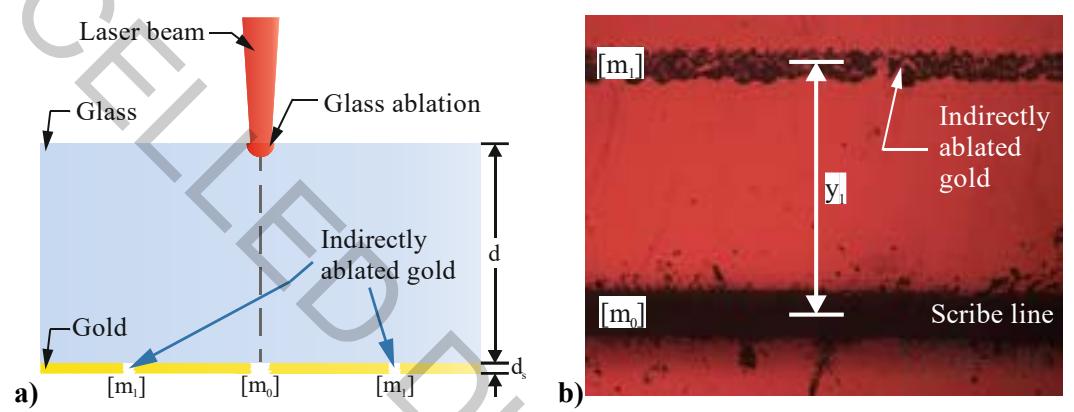
In order to further investigate this phenomena picosecond pulsed laser ($\lambda_{IH}$ = 1064 nm, $\lambda_{IIH}$ = 532 nm) with galvanometer scanner were used. Experiments varying glass thickness, gold film thickness, laser wavelength, laser polarization and beam angle of incidence were performed (Fig. 2).
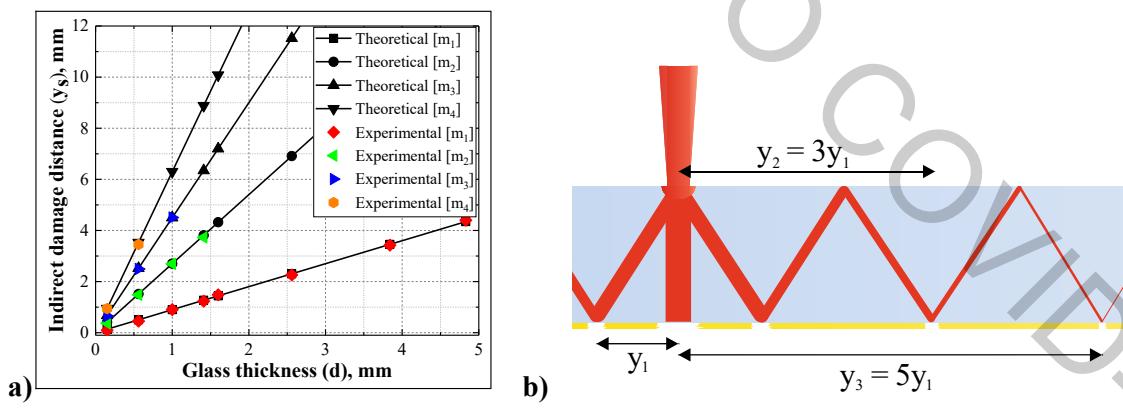
Theoretical calculations of Fraunhofer diffraction were performed and compared with the experimental data. It was concluded, that indirect ablation of thin gold layer is due to the laser beam diffraction from the glass ablation area, where laser beam interaction with the medium reduces its transparency.