
Chirped mirrors (CMs) are special type of dielectric multilayer coatings intended for stretching or compressing of ultra-short (femtosecond) laser pulses. Various types of CMs were proposed in the past: double chirped mirrors (DCMs), back side coated chirped mirrors (BASIC), complementary CM pairs, and other [1]. All of these CM configurations were implemented to reduce spectral oscillations of group delay dispersion (GDD): parameter, indicating the stretching or compressing magnitude of the mirror. Such effort allowed to compress optical pulses below 2 fs using complementary CM pair approach [1].
However, oscillation-free GDD spectral bandwidth of standard single CM is limited to half optical octave for standard coating materials [1] (e.g. $\Delta\lambda \approx 200$ nm at wavelength $\lambda = 800$ nm). Modifications of CM to overcome this issue require either cumbersome mechanical matching (e.g. BASIC approach) or supreme deposition accuracy (e.g. complementary CM pair approach). Recently, an easier way to expand the spectral bandwidth of CM was suggested. New type of CM was proposed and tested implementing the last ultra-low refractive index layer (e.g. $n< 1.25$ for porous SiO2 material) to the common CM structure [2, 3]. In this way it is possible to achieve oscillation-free GDD performance from single mirror over broad optical spectrum. So far low-ripple chirped mirrors were deposited covering 240-340 nm spectral bandwidth. The purpose of this study was to extend such CM bandwidth up to 400 nm.
In this work, ion beam sputtering (IBS) technology and glancing angle deposition (GLAD) setup within electron beam evaporation coating plant were implemented to deposit chirped mirror coating (Fig.1a). 51 layers of Nb2O5/SiO2 materials were deposited using IBS technology. The last (52nd) layer of the coating was deposited with GLAD technology (layer consisting of vertical columns was formed) [4]. To calculate the design of the mirror, a trade-off was made between several limiting parameters of final element. Firstly, relatively high refractive index ($n\approx1.23$) was chosen for the last layer material. More porous layer would allow to further decrease theoretical GDD oscillations. However, denser layer reduces sensitivity to environmental conditions (humidity). Secondly, relatively low coating thickness (less than 5.4 μm) permitted lower reflectance (R) value, but more accurate layer thickness control and thus lower GDD oscillations.
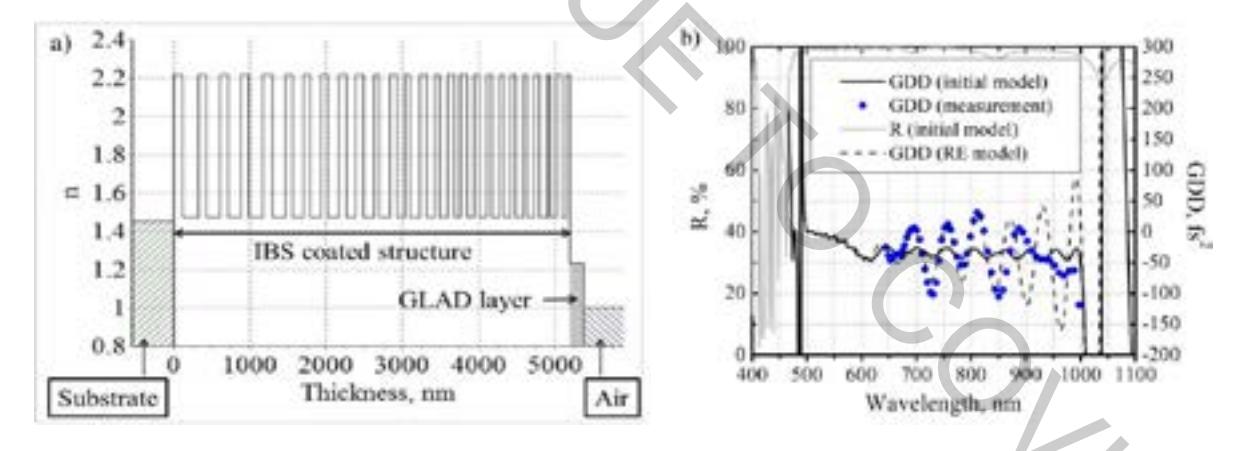
Initial GDD measurements indicate that spectral oscillations do not exceed $-35\pm100~\rm fs^2$ limits (Fig.1b). Reverse engineering (RE) procedure of deposited layer thicknesses and refractive indices was done according to transmittance and GDD measurements. This analysis showed that roughly only one third of the increase of oscillation amplitude had been caused by IBS deposition errors. Therefore, the main source of discrepancy of spectral parameters was instability of GLAD process.
Further investigations in GLAD layer repeatability and stability will be carried out to improve CM performance.