In the electrochemical energy storage field, nanomaterials have established their position as a common solution to gravimetric capacity and cyclability of a cell related problems. There is a diversity of synthesis routes to produce nanostructured materials with desirable structure and properties. Most of them usually require sophisticated devices and preparation which cannot be easily scaled to industrial needs (e.g. MBE, MOCVD) or require many time-consuming steps of synthesis in various conditions (like sol-gel method).
Some time ago, interesting compounds with the composition LiMBO3 (M = Fe, Mn) have emerged as potential cathode materials for Li-ion batteries [1]. The polycrystalline samples of those have exhibited low electronic and ionic conductivity which has led to insufficient gravimetric capacity and cyclability. Herein, we present our recent results of studies on selected physical properties of LiMBO3 glasses and compounds obtained by their thermal nanocrystallization. Usage of glasses may lead to some impressive results. Previously, we have successfully applied this method e.g. in case of LiFePO4-like system: Li2O-FeO-V2O5-P2O5. The heat-treated materials exhibited an advantageous microstructure and significantly enhanced electric conductivity (up to 10 orders of magnitude!) [2].
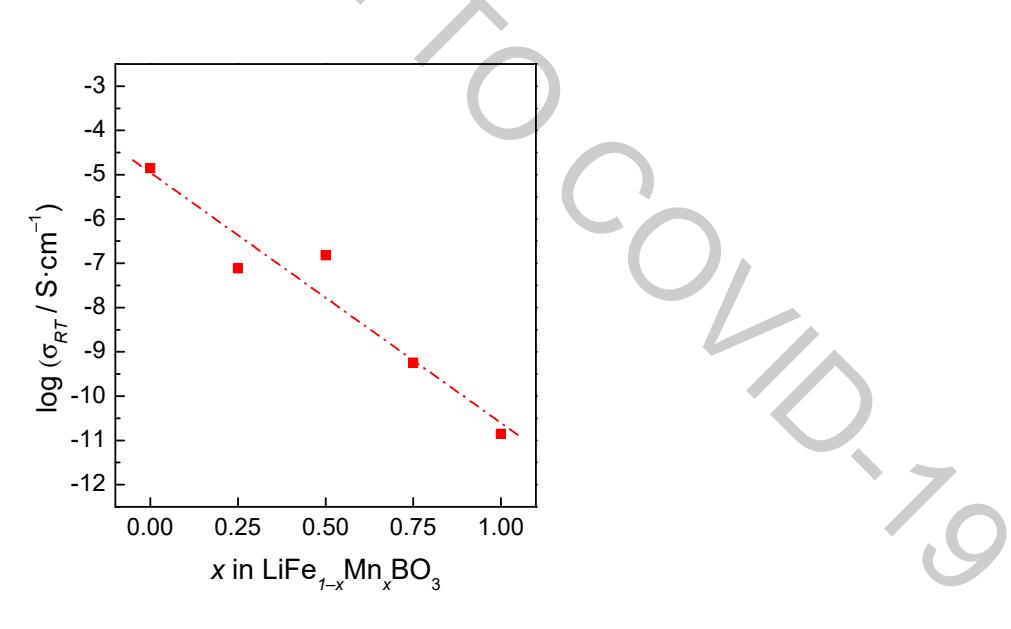
In this work, LiFexMn1-xBO3 (x = 0, 0.25, 0.5, 0.75, 1) glasses were successfully synthesized and subsequently nanocrystallized. Glasses were obtained using melt-quenching method and characterized with thermal (DTA), structural (XRD, SEM) and electrical (IS) methods. Also nuclear magnetic resonance (NMR) was used to study the local environment of lithium ions. Manganese-rich samples exhibited better glass-forming properties, but the increase of electric conductivity after nanocrystallization was modest and the final conductivity was quite low. Addition of iron led to better conductivity and higher increases after nanocrystallization, but caused worse glass-forming properties. The dependence of log(conductivity) on composition were linear (Fig. 1). These interesting results may be explained on the basis of Mott's theory of electron hopping. Also, by NMR and SEM methods, the presence of two lithium environments were proposed. The electrochemical activity of glasses and nanomaterials was also evaluated. LiFeBO3 nanocomposites are able to reach gravimetric capacity of 300 mAhg-1 under low charge/discharge currents.