
Photopolymerization is the rapid formation of cross-linked polymers from monomers under the influence of the light. Photopolymerization can be initiated by UV-, visible- and rarely by IR-light [1]. In the last years vanillin and its derivatives were used in polymer synthesis as their aromatic resins provide high rigidity and thermal stability of the resulting polymers [2].
In this study two commercially available vanillin derivatives, vanillin dimethacrylate (VDM) and vanillin diacrylate (VD), were tested in thiol-ene photocurable systems with 1.3-benzenedithiol (1.3BDT) and without 1.3BDT. Phenylbis(2.4.6-trimethylbenzoyl)phosphine oxide (BAPO) was selected as photoinitiator and dichloromethane (DCM) was used as solvent.
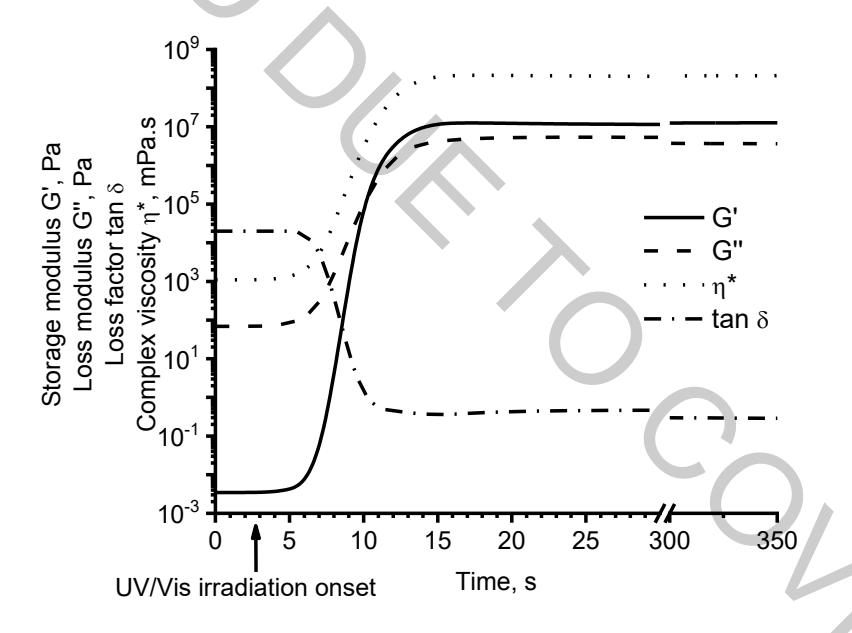
Real-time photorheometry was used to monitor the evolution of thiol-ene and free-radical photocross-linking process. As an example, the dependencies of storage modulus G', loss modulus G'', loss factor $\tan\delta$, and complex viscosity $\eta^*$ of the resin VD/3BAPO on irradiation time are presented in Fig. 1. When irradiation of the resin started, the values of storage modulus G', loss modulus G'', and complex viscosity $\eta^*$ started to increase indicating the beginning of the cross-linking process. The onset of gelation process is described as the gel point ($t_{gel}$), i.e. the point at which G' and G'' modulus curves intersect [3]. As the irradation of the resin proceeded with time, the values of G', G'' modulus, and $\eta^*$ continued to increase due to the gel aging and settled down into a steady-state indicating the end of the cross-linking process. All vanillin-based resins investigated in this study showed the similar behaviours.
Real time photorheometrical studies showed that in most cases the addition of solvent and 1.3BDT slowed down the photopolymerization process and thus the less rigid polymers were obtained.