Polyoxotungstates have a variety of interesting properties, which determine the main areas of their using as organic synthesis catalysts, radioactive waste disposal materials, anticorrosion coatings, antiviral and antitumor medicines, etc. Considering this, the search of new synthesis procedures, and the structure and properties characterization of this compounds is an actual research problem.
Usually, isopoly tungstates of the d-metals are synthesized by the self-assembly reactions in aqueous solutions, which are acidified to the needed acidity ($Z = C(H^{+}) / C(WO_{4}^{2-})$). This synthesis method is simple, fast, convenient, and takes minimum of energy. The existence areas of isopoly anions are quite long, so the synthesis can be done in a wide range of pH values of solution, which is set by different acidity values.
Various forms of paratungstate anion are mainly formed in solutions with a pH close to neutral, which corresponds to a range of acidity from 1.00 to 1.40: $[H_{n}W_{12}O_{40}(OH)_{2}]^{(10-n)-}$, $n \le 3$: Z = 1.17, n = 0; Z = 1.25, n = 1; Z = 1.33, n = 2; Z = 1.42, n = 3. The stoichiometry of the starting isopoly anions, which is determined by the reaction $12 WO_{4}^{2-} + (14+n) H^{+}$, and salts, which are formed, has already been sufficiently studied for $Z \ge 1.17$. While the question of the low acidity range of $1.00 \le Z \le 1.17$ is still unclear.
In this regard, the solution of orthotungstate anion, which contained cadmium cations in a molar ratio $C(Cd^{2+}):C(WO_{4}^{2-}) = 1:6$, was acidified to Z = 1.00. The pH-potentiometric titration of this solution was carried out with an increment $\Delta Z = 0.02$ by the acid and alkali in the acidity intervals Z = 1.00-1.68, and 1.00-0.74, respectively. Ionic strengths (I = 0.05, 0.10, 0.20, 0.30, 0.40, and 0.50 mol·L-1) in the solutions were created by adding the required quantity of a NaNO3 solution before the titration. Based on the titration results, a modeling in the CLINP 2.1 software showed that the Anderson heteropoly anions, which were expected at this acidity $Cd^{2+} + 6 WO_{4}^{2-} + 6 H^{+} \leftrightarrows [Cd(OH)_{6}W_{6}O_{18}]^{4-}$, didn't formed. Therefore, there was a problem of creating a model, that, on the one hand, would describe, the formation of isopoly tungstate anions, and, on the other hand, would consider the presence of Cd2+ cations without the formation of a heterogeneous system. For this, the interaction in the system was studied first by the conductometric method.
It was found that the conductivity change in the solution of Na2WO4 acidified by HNO3 to Z=1.00 during adding a solution of Cd(NO3)2, is not linear. A parabolic dependence of conductivity changes values from the ratio $[C(Cd^{2+}):C(WO_{4}^{2-})]$, with a minimum at a point that corresponds to the ratio (1.10:12.00), was obtained. This can be explained by the presence of ion pairs between the possible cadmium cations and the isopoly tungstate anions of the 12th row.
As a result, among a number of tested models, there was selected a model which contains a ion pairs $[CdOH^{+}, W_{12}O_{40}(OH)_{2}]^{9-}$, $[Cd^{2+}, W_{12}O_{40}(OH)_{2}]^{8-}$, $[Cd^{2+}, HW_{12}O_{40}(OH)_{2}]^{7-}$, $[Cd^{2+}, H_{2}W_{12}O_{40}(OH)_{2}]^{6-}$, $[Cd^{2+}, W_{12}O_{38}(OH)_{2}]^{4-}$, $[Cd^{2+}, HW_{12}O_{38}(OH)_{2}]^{3-}$. This model explains the homogeneity preservation of the system with rather high content of free ions Cd2+ and WO42-. The model has the low criterion function value CF = 27.39, the good global adequacy criterion $\chi^{2}_{exp} = 7.94 << \chi^{2}_{f, \alpha=0.05} = 58.12$ and is not redundant. The logarithms of concentration constants of the anions formation at appropriate ionic strengths, which were obtained by the modeling, were then used to calculate the logarithms of thermodynamic constants $IgK^{0}$ by the Pitzer method.
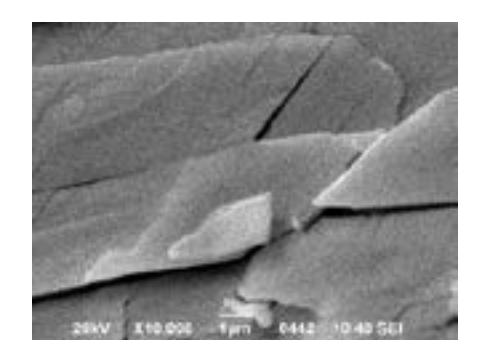
The synthesis was done at room temperature in an aqueous solution acidified to Z = 1.00, $C(Na_{2}WO_{4}) = C(CH_{3}COOH) = 0.10 \text{ (mol} \cdot L^{-1})$, with adding the solution of cadmium nitrate $C(Cd(NO_{3})_{2}) = 1.67 \cdot 10^{-2} \text{ (mol} \cdot L^{-1})$. As a result, after 2 days, the precipitate of colorless salt was formed. The single-phase nature and composition of the isolated salt Na2Cd4[W12O40(OH)2]·22H2O were found by chemical analysis and scanning electron microscopy. The presence of paratungstate B anion in the salt composition was shown by FT–IR spectroscopy. The study of surface micromorphology showed that salt exists in the form of plates with 150-295 nm grain sizes (Fig. 1).