
Despite recent progress in medicine there still are many challenges in the fight against cancer. Nanotechnology tools have potential to improve early cancer diagnostic and therapy. One of the possible ways to improve cancer treatment is to combine diagnostic and therapeutic properties, creating multifunctional theranostics agents. The concept of theranostics emerged around 2002 and within the past decade has transformed into a rapidly expanding field that is located at the interface of diagnosis and therapy.
In our study, we present a new generation theranostic nanomedicines. The theranostic approach within these nanoparticles is functionally decoupled, meaning that the therapeutic or diagnostic faculties are prompted individually, on-demand, by the wavelength specific optical excitation. Decoupled rare-earth nanoparticles (dNPs) operate entirely in the near-infrared (NIR) spectral region, for minimized light interference with target and extended tissue depth action. Heating-free 806 nm irradiated dNPs behave solely as high-contrast NIR-to-NIR optical probes. While exclusively excited by light of 980 nm, dNPs can prompt a therapeutic effect via upconversion emission in the UV/blue spectral regions.
Specifically, we have made multilayered LiYF4:Tm3+,Yb3+@LiYF4@LiYF4:Nd3+ nanoparticles that behave as dNPs in early cancer diagnostics and photosensitized tumor therapy [1]. dNPs optical properties in vitro were explored upon 806 nm and 980 nm excitation to prove that dNPs have NIR downshifting emission under heating-free 806 nm excitation and UV and blue radiation when dNPs are excited by the therapeutic 980 nm light. Also, dNPs' cytotoxicity and uptake in cancer cells were evaluated. Moreover, as an example, we formed a dNPs and photosensitizer chlorine e6 (Ce6) (dNPs-Ce6) complex that was able to generate reactive oxygen species solely under 980 nm of excitation, and cause cancer cell death in 2D and 3D cell cultures.
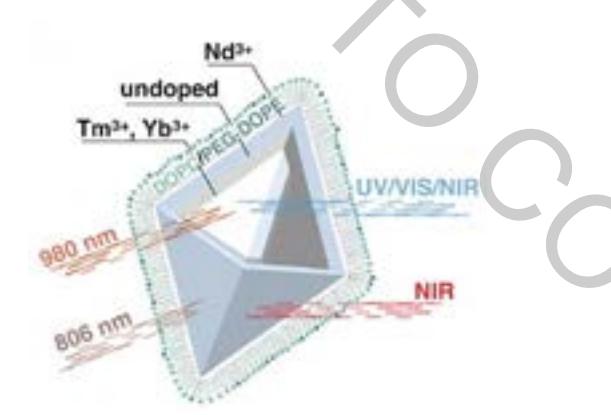
Overall, these dNPs represent a new class of theranostic agents in which the therapy and diagnostics are not prompted simultaneously, but rather on-demand, potentially increasing the safety and versatility of such nanostructures in the future.