Nowadays, development of more efficient and (or) cheaper photodetectors, solar cells, photodiodes or other optoelectronic devices is associated with organic and hybrid structures. There are many photo-electric, electric and spectroscopic techniques for the study of transport and recombination in the layers of pure materials, but these techniques give only an initial understanding about the processes in multilayer structures. For example, the changes in charge carrier recombination rate in multilayered structures could vary with the morphology, formation of the interface states and changes in the charge carrier transport.
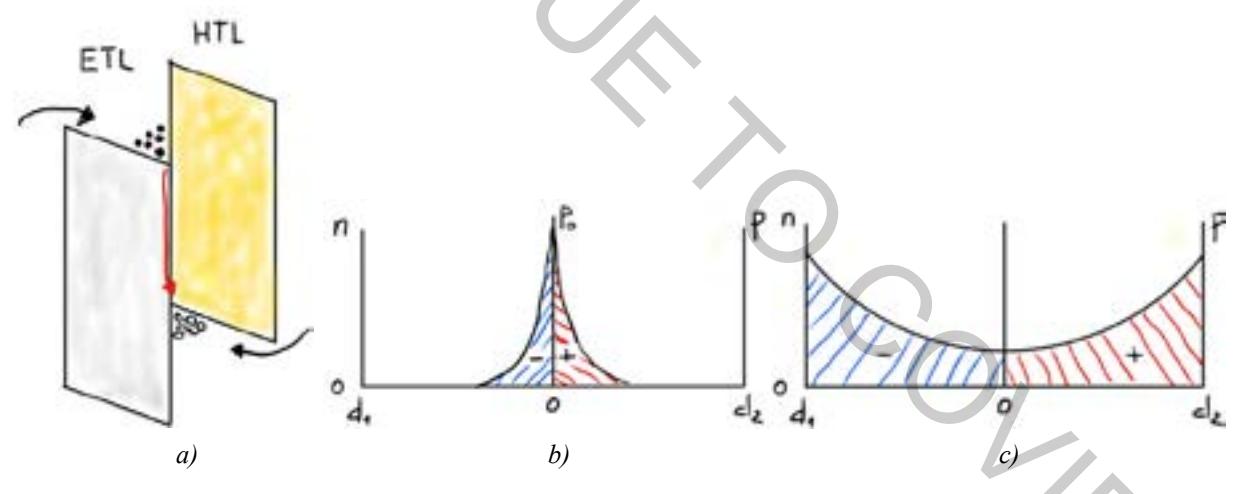
Herein we report new method for the investigation of charge transport and recombination in multilayered structures. This method is based on extraction of injected charge carriers by linearly increasing voltage (i-CELIV) [1]. In the case of double injection into a structure, consisting of hole and electron transporting layers, charge accumulates at the interface of two materials (Fig. 1) and the stationary current will be determined by recombination. In this case, the surface recombination rate can be found by measuring density of injection current $j$ and extracted charge from the device Q[2]:
$$v = \frac{2kT\varepsilon\varepsilon_0 j}{eQ^2} \tag{1}$$
This equation is derived by assuming that charge recombination is very weak, meaning that current flowing through the device is close to zero and charge distribution is determined by electric field and diffusion (Fig. 1b). If recombination is strong at the interface, charge carriers distribution is governed by space charge limited current (SCLC) (Fig. 1c). This method can be directly applied to dye sensitized solar cells, where the active layer is very thin. However, application of such technique in perovskite and bulk heterojunction solar cells is limited: only total recombination losses in the device can be estimated, since recombination takes place in the bulk but not at interface. In order to eliminate this drawback, the bulk heterojunctions were studied, the results were then compared with numerical calculations and other data obtained using different methodologies.