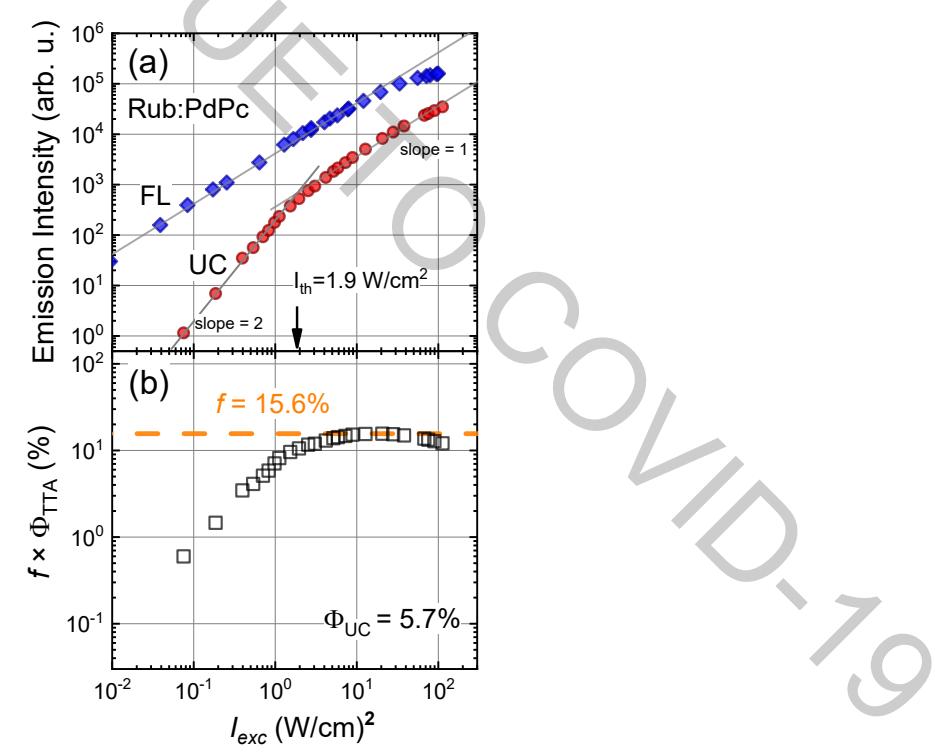
The growing interest in triplet-triplet annihilation (TTA) mediated light upconversion (UC) utilizing organic compounds is associated with potential applications in photocatalysis, bioimaging, stress sensing, night vision, memory devices, photovoltaics, targeted drug delivery and many others [1-2]. Although numerous efficient UC systems with a quantum yield ($ \Phi_{UC} $) of up to ~30% were demonstrated in the visible (vis) spectral region, only a handful of molecular systems was shown to produce near-infrared-(NIR)-to-vis UC with $ \Phi_{UC} $ above 2%. Lack of efficient IR-to-visible UC devices is partly attributed to a limited number of efficient triplet sensitizers in the IR range, which suffer from large non-radiative losses [3]. Another less studied issue in such systems is related to low statistical factor (f) representing probability to obtain a singlet from two emitter triplets via TTA.
In this work, we investigate limiting factors of NIR-to-vis UC in the systems consisting of novel (Pd,Pt)phthalocyanine (Pc) sensitizers coupled with most popular TTA emitter rubrene (Rub). The study focuses on UC in both liquid as well as rigid environment best suited for practical application. Rubrene is additionally modified with tert-butyl side groups to preserve high emission quantum yield ($ \Phi_{FL} $) at high concentrations, which are required for efficient triplet diffusion and TTA. Since the UC systems are sensitive to oxygen, all UC samples were fabricated and encapsulated in nitrogen ambient (with O2 and H2O level < 0.1 ppm). Sensitizer and emitter concentrations were varied to obtain efficient triplet transfer that was estimated to be up to 82%. A key limiting factor in the optimized liquid UC systems was found to be rubrene's low statistical probability ($ f = 15.5 \pm 3\% $) to obtain a singlet from two triplets via TTA (see Fig. 1). Modified t-butyl-rubrene demonstrated 3-fold lower statistical factor ($ f = 5.3 \pm 1\% $) as well as reduced triplet energy transfer ($ \Phi_{TET}=52\% $) and thus lower $ \Phi_{UC} $. Interestingly, the opposite result was obtained in rigid films. The 4-fold higher UC efficiency of t-butyl-rubrene films was determined by reduced singlet fission and thus higher $ \Phi_{FL} $. The obtained results strongly encourage to search for new alternatives to popular rubrene emitter.