Electrospun nanofibers incorporated with antimicrobial agents have been produced with antimicrobial capability against a wide range of microorganisms. The morphologies and performance of antimicrobial electrospun nanofibers are emphasized and specific attention is given to future application of electrospun nanofibers with antimicrobial capability. The porosity of the structure of the nanofibers is not evaluated, although it can be considered as a structural imbalance. Many people may ask for materials containing barrier properties such as to prevent any harmful effects on the human body, and because of this there are many additional substances that can have an antibacterial effect and can easily get into the structure, but there are many people who are allergic to such substances as silver or zinc. Therefore, it is necessary to block the path to the bacteria without additional added substances.
Nanofiber web structures formed by electrospinning are influenced by many factors. Analyzing the various literature sources about the electrospinning process, the authors' opinion often differs, due to the influence of various parameters on porosity of nanofibers. Analyzing the SEM images of the webs formed during the research, it was observed that the web is formed by pores of different sizes [1-2].
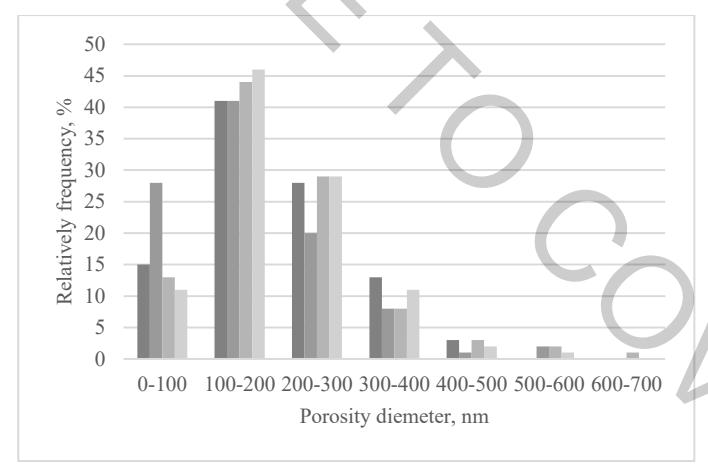
Analysis of 4 series of measurements shows that the character of distribution in all cases was obtained very similarly – the average value in all cases was obtained in the column of modal value of distribution, i.e. at 100-200 nm. All distributions have the similar positively skew and the coefficient of asymmetry A, which evaluates the skewness of distribution, was obtained in the range of 1.4. Such not low skew shows an important difference from classical normal Gausian distribution. It means that we cannot use classical statistical evaluation of obtained distributions and cannot predict the highest value of possible pore size without additional analysis of distribution.
The highest differences were obtained in the maximum pore of all measurements of 4 series – twice it was obtained that maximum pore is in the range 500-600 nm, once in the range 400-500 nm, and once in the range (for example Fig. 1) of 600-700 nm. It means that sometimes in electrospun web we can find the pore whose range is not similar to other series of measurements. This phenomenon creates a big difficulty for maximum porosity of all web evaluation. On the other hand, only once it was found that a pore of web is much higher than in other series – only one pore had the diameter higher than 600 nm, i.e., it had 667 nm, and the next after maximum pore was similar to the cases of maximum pore of series No.2 and No.4, i.e., the diameters were in the range of 580 nm. The difference between the maximum pore and the second one is not very high – only 13% in all series of measurements [3].