Biocompatible plastics are used for many different purposes (catheters, artificial heart components, dentistry products, etc. [1]). One important field is the use of specifically designed surfaces from these types of materials to be used as vision implants. It is estimated that half of the white Americans at the age of 75 or above have developed cataracts [2]. A cataract is the clouding of the lens in the eye which leads to a decrease in vision quality.
This condition may be curable by surgically replacing the original eye lens with an artificial lens, known as an intraocular lens (IOL). One of the most favorable materials in IOL manufacturing is hydrophilic acrylic – a soft, biocompatible polymer. Typically, curved surfaces are manufactured by applying abrasive grinding method via CNC machines. In addition, 2.5D objects/surfaces can also be manufactured by means of laser micromachining, however, due to the light-matter interaction mechanisms, the surface of the micromachined objects appears rough (> 1 µm Ra) therefore is not usable for optical applications. These surfaces may be polished via mechanical methods, however, the process may take up to a few days [3], which makes it economically challenging. To speed up this process, alternative ways to polish IOLs are on the search.
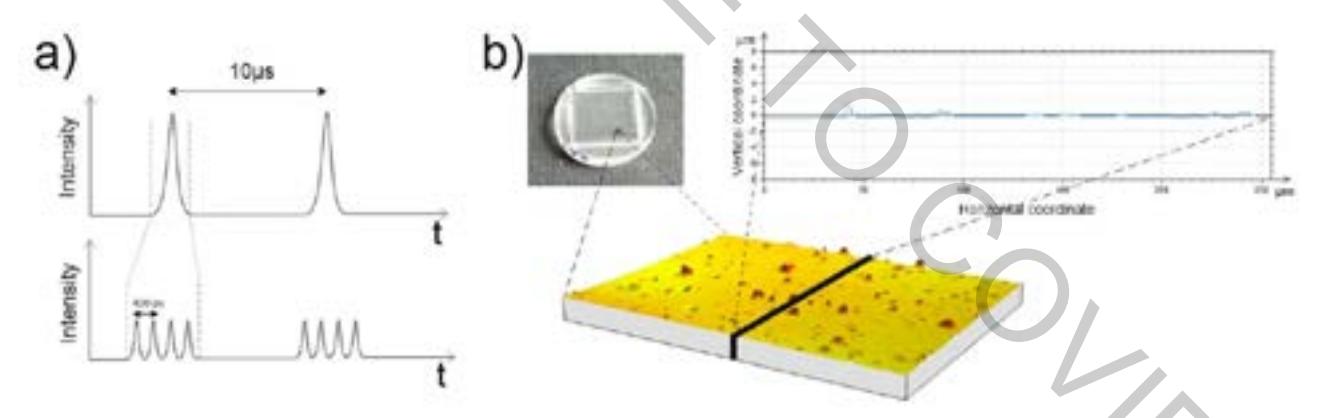
The aim of this study is the investigation of the polishing capabilities of rough (> 1 µm Ra) hydrophilic acrylic surfaces using bursts of femtosecond laser pulses (laser "Carbide"). To start off, femtosecond laser pulses were divided into burst packets of 2, 5, 10, 25 pulses. By changing the burst envelope parameter, different configurations of sub-pulse amplitudes were obtained. It was determined that it is possible to level all sub pulses within the burst to the same value with the error of 10%. The next step was the preparation of samples, where a surface area of (10x10) mm was ablated up to a depth of 0.5 mm. As was expected, the surface after ablation was rough and non-transparent. Afterwards, surface polishing experiments were conducted using a galvo-scanner based scanning/focusing system. By changing the average laser power, the scanning velocity of the beam on the surface of the sample, the line scanning pitch and the number of sub-pulses within the burst it was possible to find a regime where the surface roughness can be minimized to 88 nm Ra (the initial value of ~ 1 µm). The produced surface resembles a transparent appearance (see fig. 1b). It was determined that using bursts of femtosecond laser pulses the surface quality can be increased by ~10-fold compared to using the conventional femtosecond regime.