PHOTOELECTRIC ACTIVITY OF GRAPHENE/BACTERIAL REACTION CENTER NANOCOMPOSITE
Greta Urbonaitė1, Tibor Szabo2, Radmila Panajotović3, Jasna Vujin3, Tijana Tomašević-Ilić3, Ieva Bagdanavičiūtė4, Richard Cseko2, Klara Hernadi5, Gyorgy Varof6, Laszlo Nagy2
1 Faculty of Mathematics and Natural Sciences, Kaunas University of Technology, Lithuania
2 Institute of Medical Physics and Informatics, University of Szeged, Hungary
3 Institute of Physics, University of Belgrade, Belgrade, Serbia
4 Faculty of Chemical Technology, Kaunas University of Technology, Lithuania
5 Department of Applied and Environmental Chemistry, University of Szeged
6 Institute of Biophysics, Biological Research Center, Szeged, Hungary
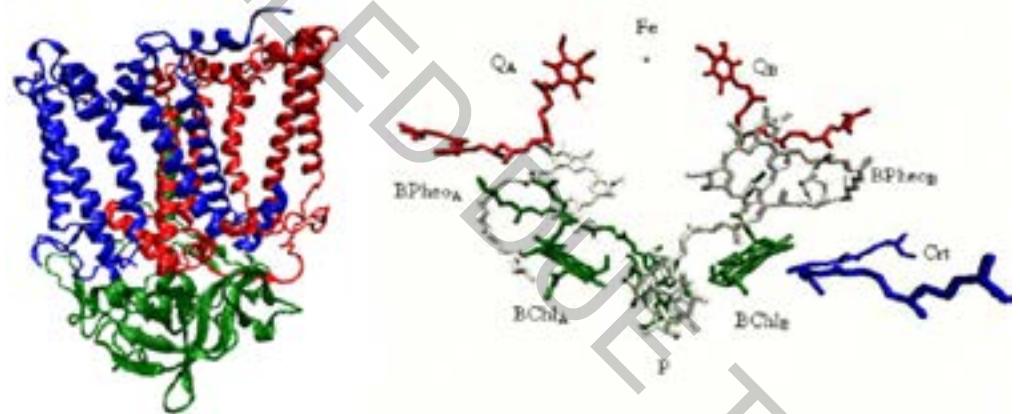
This work presents a research with one of the most important proteins for the light energy conversion, called the photosynthetic reaction center (RC) proteins [1]. They are the complexes of proteins, functional cofactors, pigments and redox active chromophores performing energy collection and primary electron transfer processes [2]. It has been indicated, that the biological activity of the RC proteins can be partly maintained by bonding them to nanostructures [3]. Here, the RC proteins were purified from Rhodobacter (Rb.) sphaeroides 2.4.1. purple bacterium (Fig. 1) and deposited on the graphene layer prepared by liquid exfoliation and light-induced resistance change was measured.
Fig. 1. The molecular model of photosynthetic reaction centre of Rb. sphaeroides. Left: three subunits (H-green, L-blue and M-red) of the protein. Right: redox active cofactors that are carrying the electron transfer [4].
The photosynthetic reaction center is able to perform photoactivity when deposited on graphene even in dried form. By measuring the temperature dependence of the resistance change of the bare and RC functionalized graphene and compared with the one inactivated by protein unfolding two effects were possible to separate. One of them is the resistance change due to the temperature effect. The other one clearly indicates a possible electric/electronic interaction between the charge flow in the graphene and the light-induced charge pair within the protein, which is, essentially, different in the open (dark, PBPheo) and closed (light, P+BPheo-) states. These results provide useful information for designing hybrid bio-photonic devices which are able to absorb and convert light energy.
[1] T. Szabó, M. Magyar, K. Hajdu, M. Dorogi, E. Nyerki, T. Tóth, M. Lingvay, G. Garab, K. Hernádi and L. Nagy, Structural and Functional Hierarchy in Photosynthetic Energy Conversion—from Molecules to Nanostructures, Nanoscale Research Letters, 10, 1-12 (2015).
[2] G. D. Scholes. G. R Fleming, A. Olaya-Castro and R. van Grondelle, Lessons from nature about solar light harvesting. Nature Chemistry, 3, 763-774 (2011).
[3] K. Hajdu, T. Szabó, A. E. Sarrai, L. Rinyu and L. Nagy, Functional Nanohybrid Materials from Photosynthetic Reaction Center Proteins, International Journal of Photoenergy, 2017, 14 (2017).
[4] L. Nagy, K. Hajdu, B. Fisher, K. Hernandi, K. Nagy and J. Vincze, Photosynthetic reaction centres-from basic research to application possibilities, Notulae Scientia Biologicae,. 2, 7-13 (2010).