
Increasing gas prices and environmental concerns have become the driving force for developing alternative energy sources in recent years. The most popular second-generation biofuels are bioethanol, produced from non-food biomass. Waste money bills (WMBs) are potential material that can be used to produce ethanol because it contains about 95% of cellulose [1]. According to the Cash Department of the Bank of Lithuania comment, WMBs are non-recyclable materials in Europe. Therefore, the filamentous fungus Trichoderma reesei is well-known as the best cellulase producer and it can be used for enzymatic hydrolysis of cellulose based material. Furthermore, Ogataea polymorpha is known as thermotolerant yeasts. The ability to grow at 50 °C is necessary to combine hydrolysis with ethanol fermentation [2].
The aim of this study is to optimize hydrolysis and ethanol production from the WMBs by using the filamentous fungus Trichoderma reese ATCC 26921 and the thermotolerant yeasts Ogataea polymorpha $\Delta$CAT8.
In this study, the pretreated WMBs samples (treated by milling and alkali treatment) were used as carbon sources for cellulase production in shake flask fermentation. The total cellulase activity was determined by filter paper assay [3]. Cellulase activity was expressed as filter paper unit for 1 g substrate (FPU/g).
Cellulase production could be significantly influenced by the effect of nitrogen sources [4]. We found that the use of soybean meal or yeast extract as nitrogen sources resulted in the highest cellulases activity (5 FPU/g). The same activity was exposed in standard Mandels medium that consists of mixture of yeast extract, urea and ammonium sulfate [5]. These medium components could be replaced with other types of nitrogen sources (e.g. soybean meal) to achieve lower costs of hydrolysis process.
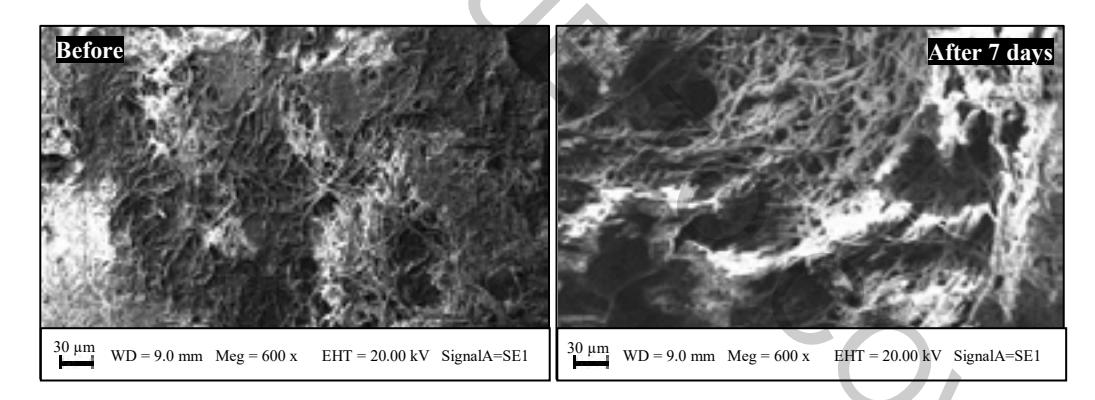
Physical changes of the WMBs were detected by Scanning Electron Microscope (SEM). The decomposition of cellulose fibers were detected after 7 days (Fig. 1.) of shake flask fermentation with soybeans meal. Significant break down of fiber surface and coverage of fungal biomass was observed.
Additionally, we determined the hydrolysis rate by using pretreated WMBs samples and fungal cellulases from shake flask fermentation (enzyme filtrate). For ethanol production we combined saccharification (hydrolysis of cellulose) and ethanol fermentation at the same time by adding yeasts to enzyme filtrate. We discovered the glucose recovery yield was 6.4% during hydrolysis. Also, ethanol concentration was 10.5 mM. It demonstrates that WMBs could be used in ethanol production. However, the yield of ethanol is low. Therefore, different temperature and inoculation times of yeasts will be tested for further researches.