
Despite of many extensive studies held on an intellectual disability, it still remains one of the most mysterious neuropsychiatric disorders. The prevalence of an intellectual disability (2-3% of the population) [1] and its variability induce active research of the etiology of this disorder. Frequently, such research directs to genetic causes of an intellectual disability. The epidemiology of this disorder is quite astonishing – there can be around 20 % more males, affected by intellectual disability, than there are females. [2] Such prevalence can explain extensive studies held on the research of X chromosome linked mutations potentially causing intellectual disorders.
After reviewing the most significant articles, published during the last 20 years and currently ongoing international studies which investigate the linkage of X chromosome and intellectual disability, it was observed that there was a constant increase of genes, associated with X-linked intellectual disability. However, it is very difficult to interpret this result because with a notable improvement of laboratory equipment many genes were identified on other chromosomes, as well. It is often a topic for debates whether all chromosomes should be acknowledged as having the same significance for the cause of intellectual disability or X chromosome is still yielding more potential to cause this disorder. [3] To address this question, we aimed to calculate the ratio of genes, associated with intellectual disability in each chromosome and to compare this ratio between the data of X chromosome and autosomes.
We listed genes associated with intellectual disability, found in OMIM and DECIPHER databases. To access the data of all protein coding genes in each chromosome, Ensembl database was used.
It was calculated that the average ratio between intellectual disability associated genes and all protein coding sequences in the chromosome was 5,43% (SD=2,72) for autosomes and 17,12% for X chromosome (Fig. 1). This difference was statistically significant (p<0,05).
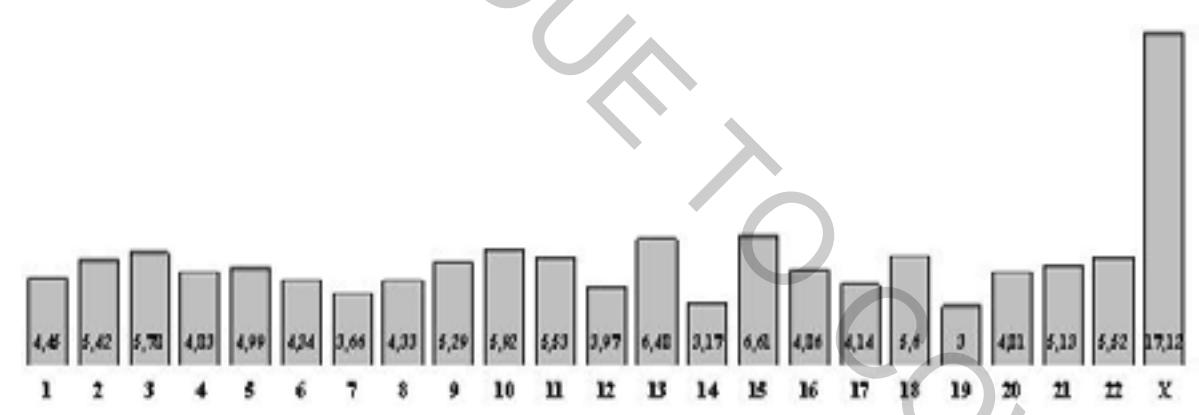
According to our results, it can be concluded that with the current knowledge, the diagnosis of X-linked intellectual disability is much more likely to occur in comparison with autosomal mutation caused intellectual disability. It is speculated that the reason for X chromosome genes to be involved in the intelligence at such a high level might be the chromosome's sequence conservation and lower recombination frequency [4] or a skewed X-inactivation when a heterozygous mutation occurs. [5]