
In the last few years, dielectric microstructures have been actively studied in order to use them in photonic devices. Organic structures have some advantages over inorganic ones due to the high tunability of their properties such as shape, size and refractive index, high luminescence yield and values of nonlinear susceptibilities. These key features bring about a wide range of photonic functions from the organic microstrucutres[1] for instance optical microresonators and light-driven single-component lasing media[2] with a possibility for tunable wavelength. In order to increase the photoluminescence (PL) efficiency, different types of optical structures are considered, including optical whispering gallery modes (WGMs) resonators.
The objects of this research are microspheres made by solvent-assisted self-assembly technique of organic dye 4-(dicyanomethylene)-2-methyl-6-(4-dimethylaminostyryl)-4Hpyran (DCM) of the typical diameter 5-10 µm (refractive index, n=1.61) on a glass substrate. Among organic dyes, DCM is a good candidate material for two-photon pumped PL devices, as it reveals high luminescent yield of nearly 0.7[3] and large two-photon absorption (TPA) cross-section.
For the NLO experiments, a two-photon confocal microscopy setup based on a femtosecond Ti:Sapphire laser operating at 810 nm wavelength is used. Fundamental radiation is focused onto a sample by objective with numerical aperture of 0.7 in a spot with a diameter of 1 µm. The spectrum of the scattered NLO signal is analyzed by a spectrometer with spectral resolution of about 1 nm.
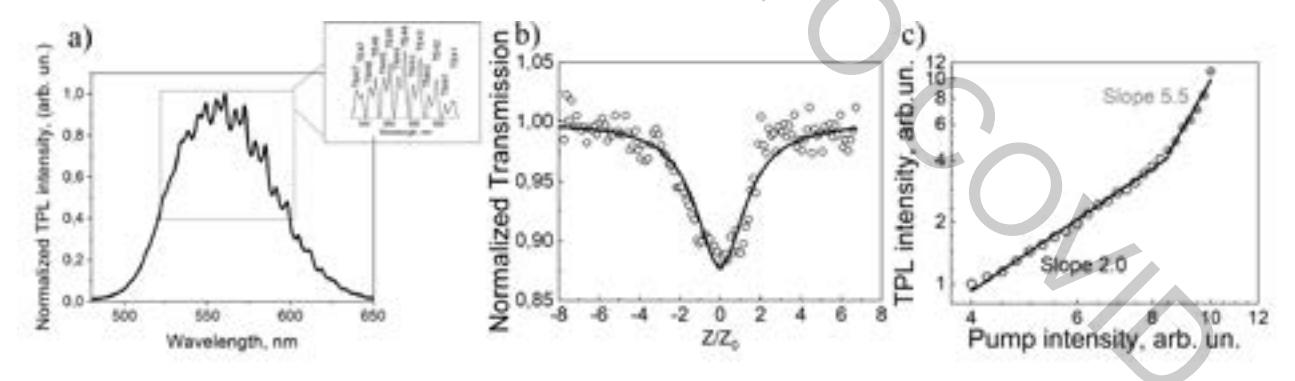
DCM microspheres shows bright two-photon pumped PL (TPL). Typical spectrum of TPL scattered signal shown at fig. 1a. This spectrum shows pronounced peaks attributed to WGM resonances. Nature of these peaks is confirmed by the dependencies of Q-factor and free spectral range on sphere diameter. To characterize nonlinear properties of single structure TPA coefficient is measured using Z-scan method (fig. 1b) and its value is equal to 4 cm/GW. Usually Z-scan technique is applied to thin films, but here we demonstrate that it can be used for microstructures.
In order to find lasing in DCM microspheres dependence of the intensity in single resonance on the fundamental radiation intensity is measured (fig. 1c). It can be seen that there is a threshold in this dependence, where the slope value changes abruptly from 2 to 5.5, which is usually intrinsic property of lasing. DCM dye is subjected to photobleaching, which appears in a decrease of PL intensity with time under strong fundamental radiation. The effect of photobleaching on intensity dependent processes in such structures was never studied thoroughly before. We proposed simple theoretical model, which took photobleaching into account. According to this model, it is shown that photobleaching in organic microspheres leads to similar threshold dependence.
Due to high field localisation, simple and low-cost production method, high quality factor and huge two-photon absorption cross-section these structures are well suitable for photonics applications.