
Atmospheric aerosols can significantly influence local and global climate. The impact of particles depends on their chemical composition and physical properties (such as optics). The the light absorption and light scattering are two main interaction processes in the atmosphere between aerosol particles and solar radiation. Large uncertainties in estimating the aerosol radiative forcing [1] urge a better understanding of optical processes in the atmosphere. Single scattering albedo (SSA) is the essential parameter of aerosol optical properties, which enables investigation of total aerosol radiative forcing effect. Therefore, SSA is a key input parameter in climate models.
We investigated aerosol optical properties during domestic heating season in Preila (rural-coastal background site). During measurement campaign in December 2017 – March 2018, we deployed an Aerosol Chemical Speciation Monitor (ACSM), a 7-wavelength Aethalometer and an integrating Nephelometer (TSI). Additional measurements included the meteorological parameters (temperature, relative humidity, solar radiation and wind speed). Absorption Angström exponent (AAE), scattering Angström exponent (SAE) and SSA were calculated. Furthermore, absorption due to coloured organics known as brown carbon (BrC) was evaluated.
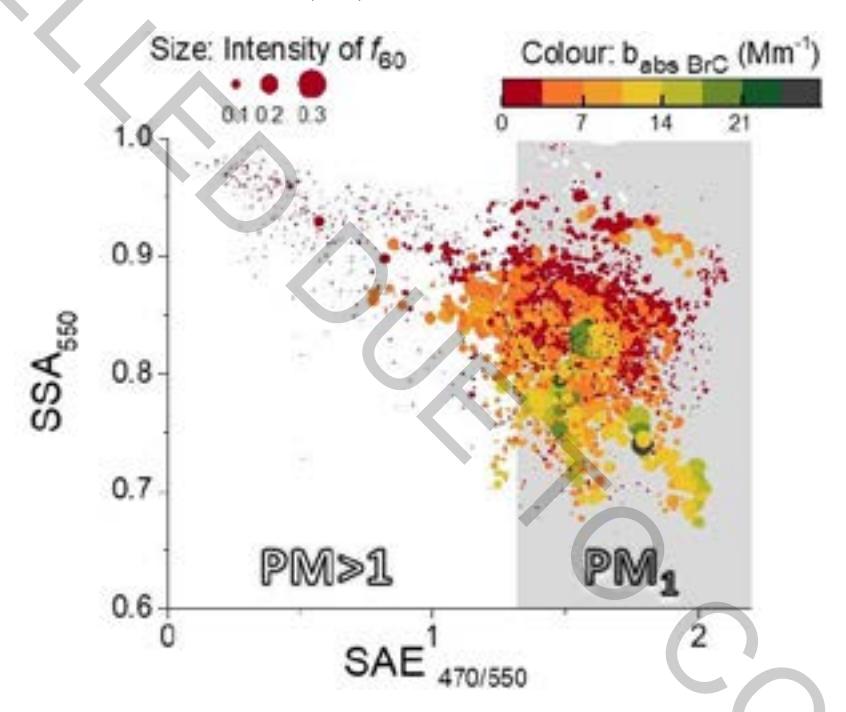
As can be seen in Fig. 1, SSA shows a strong dependence on both size and chemical composition. The lowest SSA values were reached when PM1 fraction was dominating. Furthermore, decrease in SSA could be associated with higher $f_{60}$ together with higher absorption coefficient of BrC. These results indicate fresh combustion products contribute to the atmospheric heating the most while with aging and bleaching processes the capability to heat decreases. These results will benefit in understanding the SSA sensitivity towards different atmospheric processes and to the broad extend will provide knowledge for modelling of atmospheric radiative balance.