
Compact and cost-effective TW-class peak power lasers are in demand for emerging applications in nonlinear optics, material science, biology and medicine. Since the first demonstration in 1992 [1] the Optical Parametric Chirped Pulse Amplification (OPCPA) has become an attractive alternative to Ti:Sapphire based amplifier systems and has opened a new path towards generation of few-cycle, high intensity pulses.
In the OPCPA process the resulting gain depends on the pump intensity and hence on the temporal shape of the pump pulses. In most cases pump with a Gaussian temporal profile is used and a fraction of energy is discarded, thereby lowering the overall efficiency of the parametric amplification process. If the seed and pump pulses are of comparable duration, the gain along the chirped seed pulse replicates pulse temporal shape and usually leads to the narrowing of the amplified pulse spectrum. The pump pulses with a rectangular temporal profile and duration comparable to seed pulse would provide a uniform gain for whole seed spectral range, thereby avoiding spectral gain narrowing and increasing pump-to-signal conversion efficiency.
Purpose of this study was to investigate picosecond pump pulse temporal profile influence on OPCPA performance and to determine optimal conditions for effective energy transfer and shortest amplified pulse width after compression.
Pulses with an energy up to 20 mJ, a pulse width of 1.2 ps and excellent beam quality $M^2 \sim 1.1$ at a wavelength of 1030 nm were obtained from a two-stage double-pass Chirped Pulse Amplifier (CPA) based on Yb:YAG rods [2]. Under optimal conditions, the stability of the generated white light continuum (WLC) pulse energy and beam pointing in the wavelength range from 500 to 2500 nm is several times higher than the source stability [3]. The second harmonic was generated in two successive cascades with an overall conversion efficiency of 85%, where M-shaped pulses were formed in the second cascade due to the strong depletion of fundamental radiation in the first cascade. When reducing the first SHG stage conversion efficiency, pulse temporal shape becomes flat-top or even Gaussian distribution (Fig. 1, left).
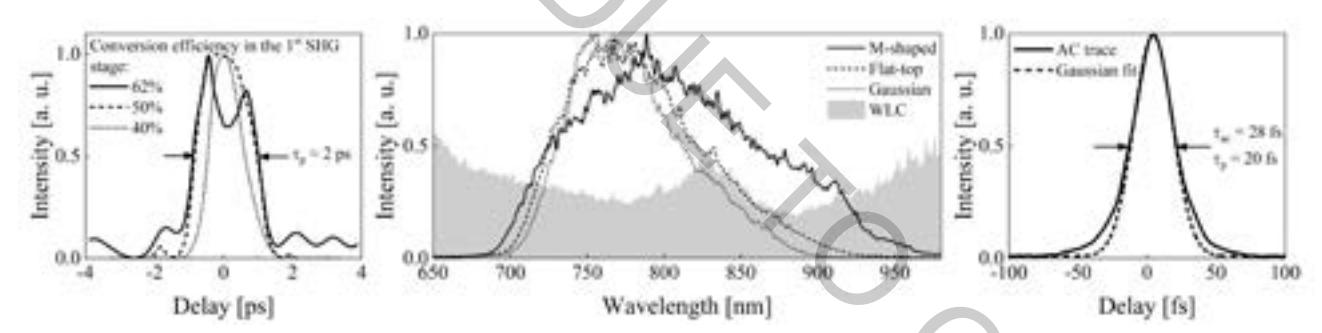
Pulses with an energy up to 14.2 mJ at wavelength of 515 nm were used to pump three OPCPA stages. The use of M-shaped pulses helped to support a wide spectral bandwidth of amplified pulses in OPCPA cascades with a high gain (Fig. 1, middle), while Gaussian pump pulses provided efficient energy extraction of 20% at the last cascade. The output energy after three stages exceeds 2.1 mJ with the support of a spectral bandwidth sufficient for a transform-limited pulsewidth of 8.6 fs. For comparison, using flat-top or Gaussian pulse temporal profile amplified signal pulse transform limit is 9,7 fs and 11 fs respectively. The measured autocorrelation trace of the pulses after prism compressor corresponds to a pulsewidth of 20 fs (Fig. 1, right). In our opinion, a combination of chirped mirrors and prisms or adaptive dispersion control would allow obtaining much shorter pulses.