Molecular magnets are compounds assembled out of discrete building blocks, e.g. coordination complexes or organic molecules, that exhibit magnetic properties and can be treated as multifunctional materials. The continuous increase in the interest in molecular magnets can be seen in recent years. Some of them can combine multiple attractive properties, such as low density, the high magnetic moment per unit of volume, or the sensitivity for external stimuli, including temperature and pressure. Prussian blue analogues (PBAs) are one of the best-known group of molecular magnets, especially due to their functional properties (sorption capacity, photomagnetism). The numerous methods of synthesizing samples in various forms (bulk, thin films, nanoparticles) create a possibility for the interesting research, for instance, the investigation of the influence of the size reduction on their magnetic properties.
In this work, we report the synthesis and study of magnetic properties of the nanorods of PBA belonging to the system Fe3[Cr(CN)6]2·nH2O. The samples were prepared by template-assisted electrochemical deposition. The porous polycarbonate (PCTE) membranes covered by a thin film of Au were used as the working electrode in a three-electrode electrochemical cell. The samples were fabricated in the polycarbonate (PCTE) membranes of two different pore size: 100 and 200 nm.
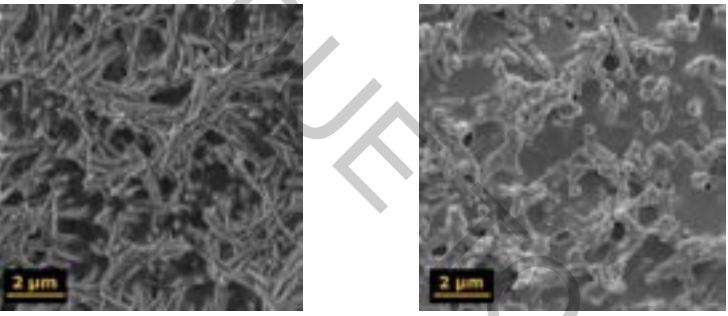
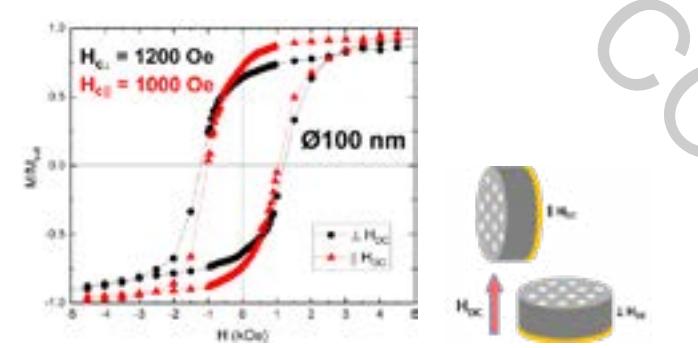
The analysis of scanning electron microscope (SEM) microphotographs confirmed that nanorods of cylindrical shape with diameters of 100 and 200 nm respectively were obtained. The measurements of magnetic properties showed that obtained materials are ferromagnets with critical temperature $T_c$ equal to 20 K. This $T_c$ value is comparable to that observed for bulk as well as thin films. The most important result in this study is the observation of the increase of coercive filed with the reduction of nanorods diameter.