Acetylsalicylic acid (ASA) is a key ingredient in anti-inflammatory pain relief medicine. It is critical to analyze structure of this molecule as it can have various conformational isomers with varying properties. The molecular structure can be studied using matrix isolation method which allows sample molecules to be trapped in noble gas matrix. The inert environment and low temperatures help prevent interactions between sample molecules and their environment. The registered spectra exhibit narrow bands from which specific information about molecular structure and its changes can be derived.
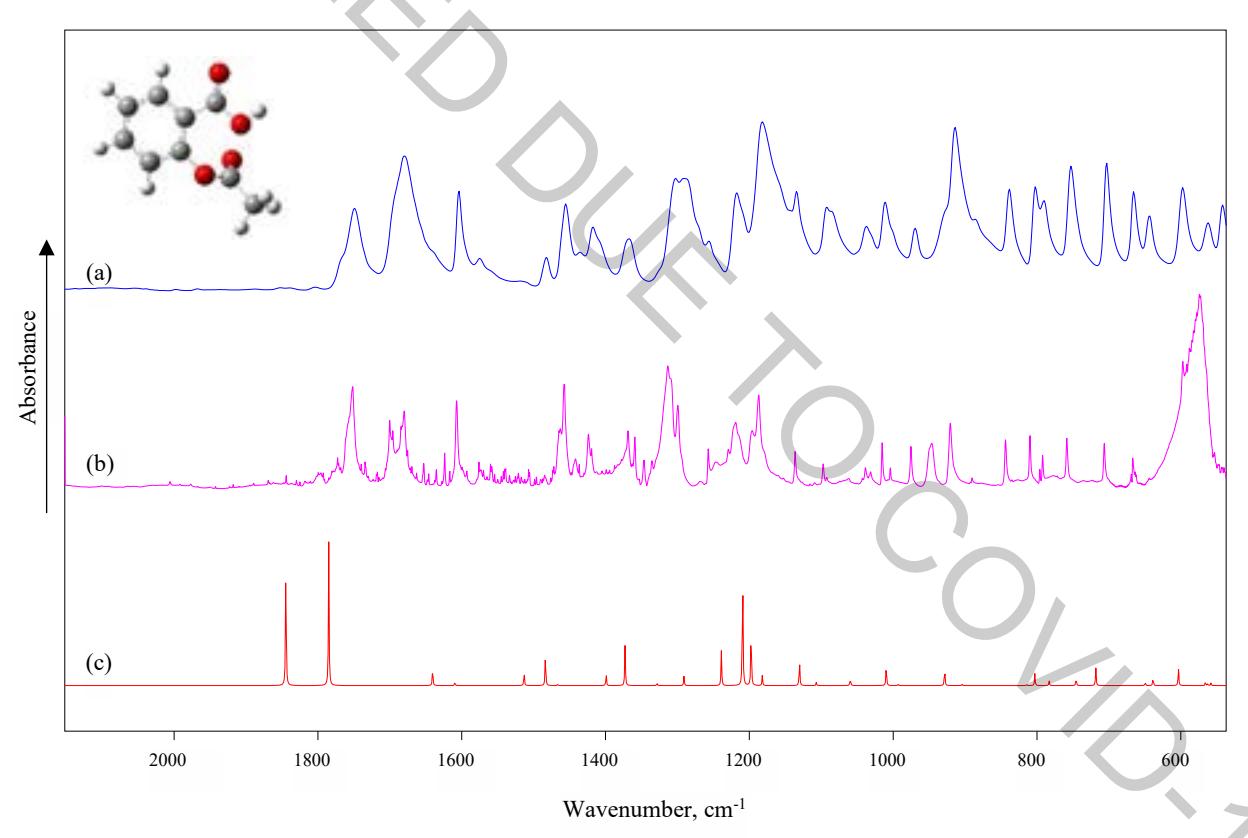
In this work, powder samples of ASA were heated to approximately 308 K temperature as the vapor pressure is too low to get a good gas phase sample otherwise. The sample-argon gas mixture was deposited on a CsI plate cooled by closed-cycle helium-refrigeration cryostat to 10 K temperature. FTIR spectrometer was used to register IR spectra of the isolated molecules. DFT calculations of molecules with the B3LYP/6-311++G (3df, 3pd) basis set were performed in order to get theoretically calculated spectra.
The isolated ASA molecule spectrum is compared with ATR (attenuated total reflection) and theoretically calculated spectra of the same molecule. ATR spectrum has naturally broad bands but it is enough to confirm that matrix isolation spectrum (fig. 1b) is needed of ASA. Although most of the peaks of spectrum correspond theoretically calculated ones, there are unassigned bands which could mean that more than one conformer may be found in argon matrix.