
Nowadays, food preservation plays a tremendous role in food industry. However, the majority of food preservatives are synthetic chemicals and most of them have a harmful effect on human health. Nisin is the one of the commonly used natural additives for dairy and canned food products. This bacteriocin is generally recognized as safe (GRAS) and has a number E234. Nisin is a small 3510 Da cationic peptide composed of 34 amino acid residues. Nisin is produced by Lactococcus lactis subsp. lactis and has the broad-spectrum antimicrobial activity against Gram – positive bacteria [1]. The action is based on the formation of pore in the bacterial cell wall [2].
The antimicrobial activity of nisin depends on its interactions with food components, other food additives and conditions used for food production. The encapsulation of nisin into micro/nano particles is a promising way to achieve nisin stability and extend its antimicrobial activity in food products for a longer time [3]. Various biopolymer systems can be used for the incorporation of nisin into particles.
This study is aimed to prepare nisin-loaded particles with different surface charge, i.e. positive and negative using biopolymers pectin and chitooligosaccharides. For nisin-loading, three different types of anionic pectin biopolymer, i.e. high methoxyl pectin (HMP), low methoxyl pectin (LMP) and pectic acid (PecA) were used. The complexation process between nisin and pectin at different pH in the range of 4.0-7.0 was performed. Prepared complexes were additionally coated using different amounts of chitooligosaccharides (Fig. 1). The final concentration of nisin and pectin was 0.1 mg/ml and 0.2 mg/ml, respectively. The concentration of cationic chitooligosaccharides was in the range of 0.025-0.5 mg/ml.
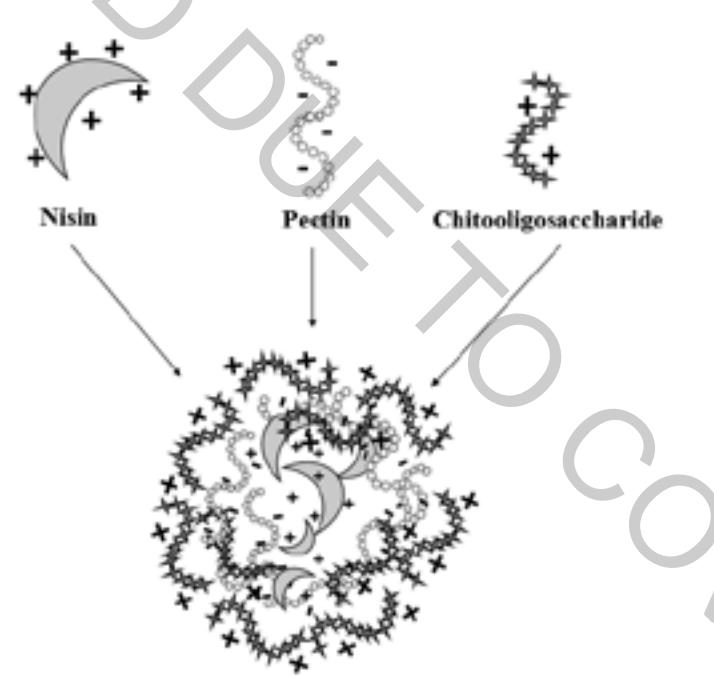
Three-component particles were analyzed by measuring their zeta-potential using Zetasizer NanoZS device. The values of zeta-potentials increased with increasing chitooligosaccharides concentration and reached positive values when chitooligosaccharides concentration was in the range of 0.1-0.3 mg/ml. The isoelectric point depended on the pH of the solution and the degree of esterification of the pectin. The nisin-loaded particles with the different surface charge could be used for the investigation of particles interactions with cells applying emerging pulse electric fields technology.