The need for clean water is ever increasing, and with limited resources of freshwater, cleaning of wastewaters is urgent issue to be solved. Textile and leather industries are ones of the most polluting ones in the world, they generate up to 200 L of wastewater per 1kg of textile. [1]
Homogenous Fenton reaction has been known since late 19th century, where mixture of iron (II) ions and hydrogen peroxide is used for degradation of various organic materials. [2] Fenton reaction offers a fast, reliable and clean way to remove all organic materials from wastewater. One of the big drawbacks of homogenous Fenton reaction is the need to remove large amounts of iron sludge after oxidation [3]. The rate and efficiency can be improved by using heterogeneous Fenton reactions, also the need to remove iron sludge can be eliminated. [3] In this study, we report an electrochemical deposition method for preparation of porous Fe/Cu foam catalyst for Fenton reaction. The efficiency of obtained catalysts has been evaluated using nitro dye - methyl orange (MO) aqueous solution.
The catalyst was deposited using potentiostatic deposition onto Cu foams. Deposited coatings morphology has been investigated using SEM with EDS module and XRD spectroscopy. Catalysts activity has been tested in 40 mg/L MO and 20 g/L Na2SO4 solution. Solutions pH was 3. Spectrophotometric and electrochemical impedance spectroscopy (EIS) were used for characterization and evaluation of deposited catalyst activity.
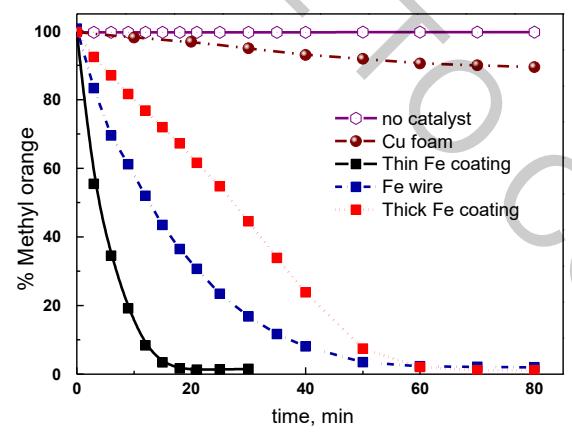
Fenton reactions rate (Eq. 1) depends on the concentration of Fe2+ ions, that are affected by the presence of Cu+ ions in the system (Eq. 2). The later ones can be obtained according to Wang [4] due to interaction of copper with H2O2 in the acidic media (Eq. 3). Thus, the use of copper foam has beneficial effect on heterogeneous reaction rate. Substantial increase in the reaction rate have been noticed if coatings are thinner (Fig. 1). We managed to oxidize 40 mg/L methyl orange in 8 min under optimum experimental conditions (Fig. 1).
$$Fe^{2+} + H_2O_2 \rightarrow Fe^{3+} + OH+OH \tag{1}$$$$Fe^{3+} + Cu^{+} \rightarrow Fe^{2+} + Cu^{2+}; \Delta E^{0} = 0.6 V \tag{2}$$$$2Cu^0 + 2H^+ H_2O_2 \rightarrow 2Cu^+ + 2H_2O \tag{3}$$