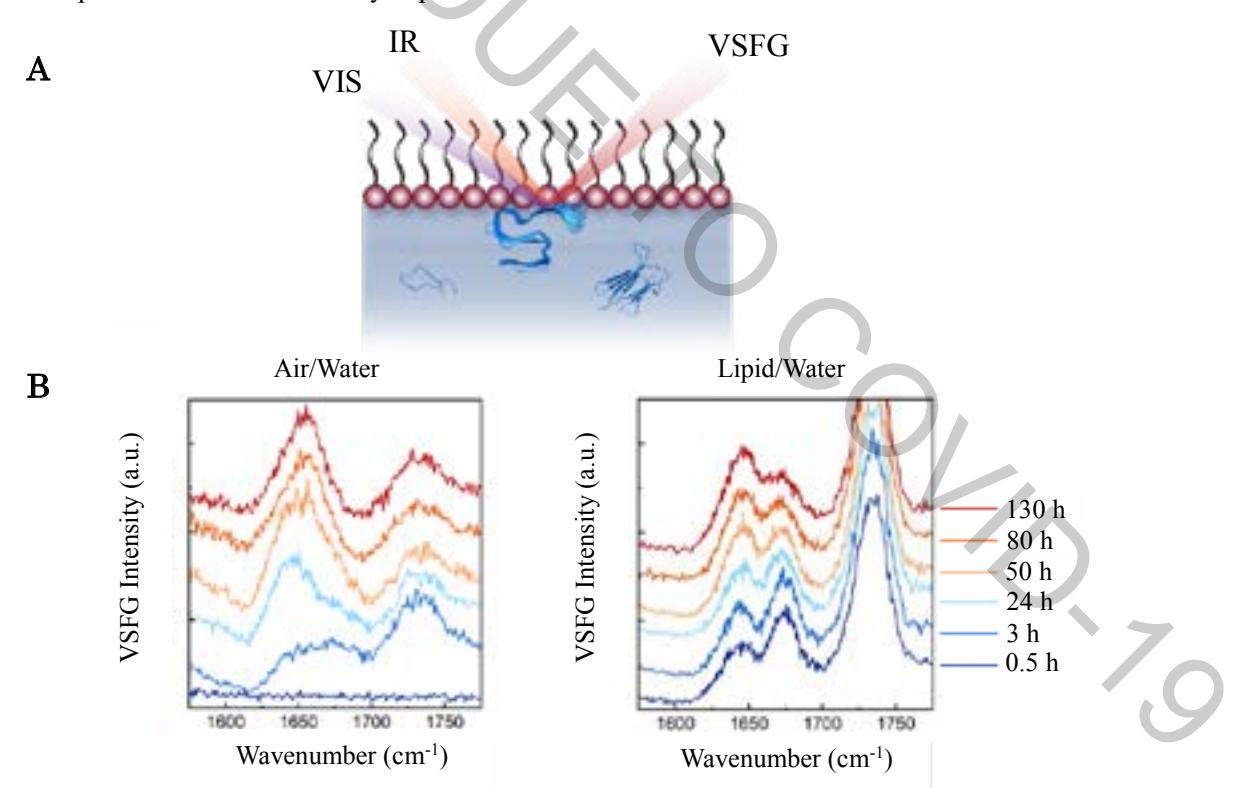
Protein aggregation is associated with more than 30 different human diseases including Alzheimer's, Parkinson's, Huntington's and others. Each of these diseases is caused by the aggregation of a particular protein, which is a normal product of a cellular metabolism, however, it starts to aggregate when production and elimination cycle is disrupted.
In order to understand protein aggregation at the molecular level, it is essential to identify the structure of protein aggregates. Many different methods are used for this purpose, for example: nuclear magnetic resonance (NMR), Fourier-transform infrared (FTIR) and Thioflavin T fluorescence (ThT) spectroscopies. These methods can only characterize the structures formed in the volume of the solution. Meanwhile, the most recent studies suggest that interaction between protein and cell membrane can accelerate protein aggregation. Thus the characterization of structures at the surface of the liquid, especially at the Lipid/Water interface, remains a major subject of the protein aggregation research. Vibrational sum frequency generation (VSFG) spectroscopy enables the detection of a single molecular layer adsorbed at any liquid surface and structure determination of the adsorbed molecules.
This paper seeks to understand and compare the adsorption behavior of hen egg white lysozyme (HEWL) and its aggregates at Air/Water and Lipid/Water interfaces. HEWL is used as a model protein to study the adsorption of aggregates and their structure. In our study Fourier transform infrared spectroscopy and atomic force microscopy (AFM) served as tools to verify the structure of lysozyme aggregates formed in the bulk solution and their morphology. Whereas measurements at Air/Water and Lipid/Water interfaces were performed using VSFG spectroscopy. In both cases, the aggregated lysozyme solution was injected below the interface. Different combinations of VSFG beam polarization were used to determine the structures of protein aggregates adsorbed at the interfaces. We found that protein in disordered form together with small aggregates, such as dimers and trimers, and larger aggregates with parallel and anti-parallel $\beta$-sheet structures, were adsorbed at both interfaces. However, adsorbtion had a very different kinetics. Adsorbtion at Air/Water interface was mainly governed by hydrophobic interaction, whereas at Lipid/Water interface, electrostatic interaction was the main driving force for adsorbtion with a possible contribution of a hydrophobic interaction as well.