
The experiment was conducted by exciting D1 line hyperfine structure (HFS) transitions in rubidium vapor. The results of this experiment show that the total angular momentum of rubidium atoms can be changed from an aligned to an oriented state also known as alignment-to-orientation conversion (AOC). When the magnetic field is zero, linearly polarized laser radiation can only create an aligned state – angular momentum is symmetrically distributed along a determined axis. When an external magnetic field is applied, the angular momentum changes its distribution due to the nonlinear Zeeman effect and starts to have a preferred spatial direction – it becomes oriented.
To create AOC, exciting linearly polarized laser radiation E forms an angle of $\pi/4$ with respect to the magnetic field B. The magnetic field B defines the quantization axis. Two circularly polarized fluorescence components are observed in the direction perpendicular to both E and B (see Fig. 1).
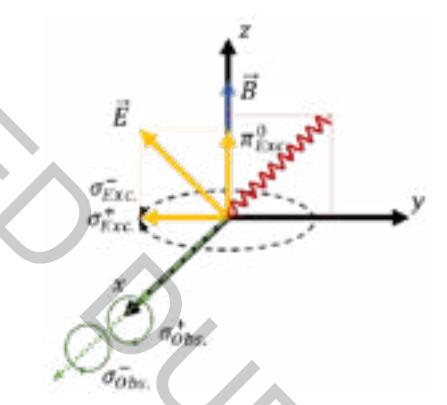
In the previous work [1], where the same excitation and observation geometry was used, the AOC phenomenon was studied in the excited state of D2 line, where magnetic sublevel crossings occurred due to the nonlinear Zeeman effect. In contrast, there are no magnetic sublevel crossings in the D1 line of rubidium and one would not expect to observe AOC. However, the results show that the difference between these two components is a non-zero signal, which is a direct indication of partial orientation of total angular-momentum. This difference normalized to the sum of the components is known as circularity.
The observed fluorescence components and their circularities were compared with theoretical data, obtained with the theoretical model [2], developed in the Laser Centre of UL, which takes into account all neighbouring hyperfine transitions, the mixing of magnetic sublevels in an external magnetic field, the coherence properties of the exciting laser radiation, and the Doppler effect.
The maximum amplitude of the observed circularity is 4%, when the laser frequency was fixed to the Fg=2→Fe=2 transition. In contrast to the observed signals when the laser frequency was fixed to other transitions where the orientation is in one direction with varying amplitude, in the case for Fg=2→Fe=3 transition the amplitude changes direction as the magnetic field changes – at relatively smaller magnetic fields the orientation is in a positive direction, but with higher magnetic fields the orientation changes to a negative direction. Additionally, when laser intensity is increased, the orientation no longer changes its sign depending on magnetic field – similarly to other transitions.